EDR Services: 2026 Guide for Alaska Businesses
What if the antivirus software you’ve relied on for years is actually leaving your Alaska business wide open to the very ransomware you fear most? It’s an unsettling thought, especially as cyber insurance premiums continue to rise and hackers become more sophisticated. Many local business owners feel the weight of these increasing threats, often without the in-house expertise to manage them. You’ve likely realized that “set it and forget it” security no longer keeps your data safe. In 2026, many organizations are turning to endpoint detection and response services because traditional tools often fail to catch modern attacks that hide in plain sight.
We understand that your priority is keeping your local operations running smoothly and meeting strict HIPAA or insurance requirements. This guide will show you how these managed services act as a dedicated security guard for your network. You’ll discover how EDR goes beyond simple scanning to provide total visibility and behavioral monitoring. We’ll walk through the specific 2026 regulatory changes and explain how a reliable local partner can handle your security alerts so you can finally have true peace of mind.
Key Takeaways
Understand how EDR acts as a digital “black box” for your network, providing the detailed visibility needed to investigate and stop complex cyberattacks.
Learn how proactive telemetry and threat intelligence work together to catch suspicious activity across your office devices in real time.
Discover the critical differences between standard antivirus and endpoint detection and response services to ensure your business stays ahead of zero-day exploits.
See how behavioral-based monitoring helps Alaska medical practices comply with the latest 2026 HIPAA Security Rule updates and insurance requirements.
Find out why a managed approach with a local partner offers the steady vigilance and technical mastery needed to handle security alerts quietly in the background.
Table of Contents
What are Endpoint Detection and Response Services?
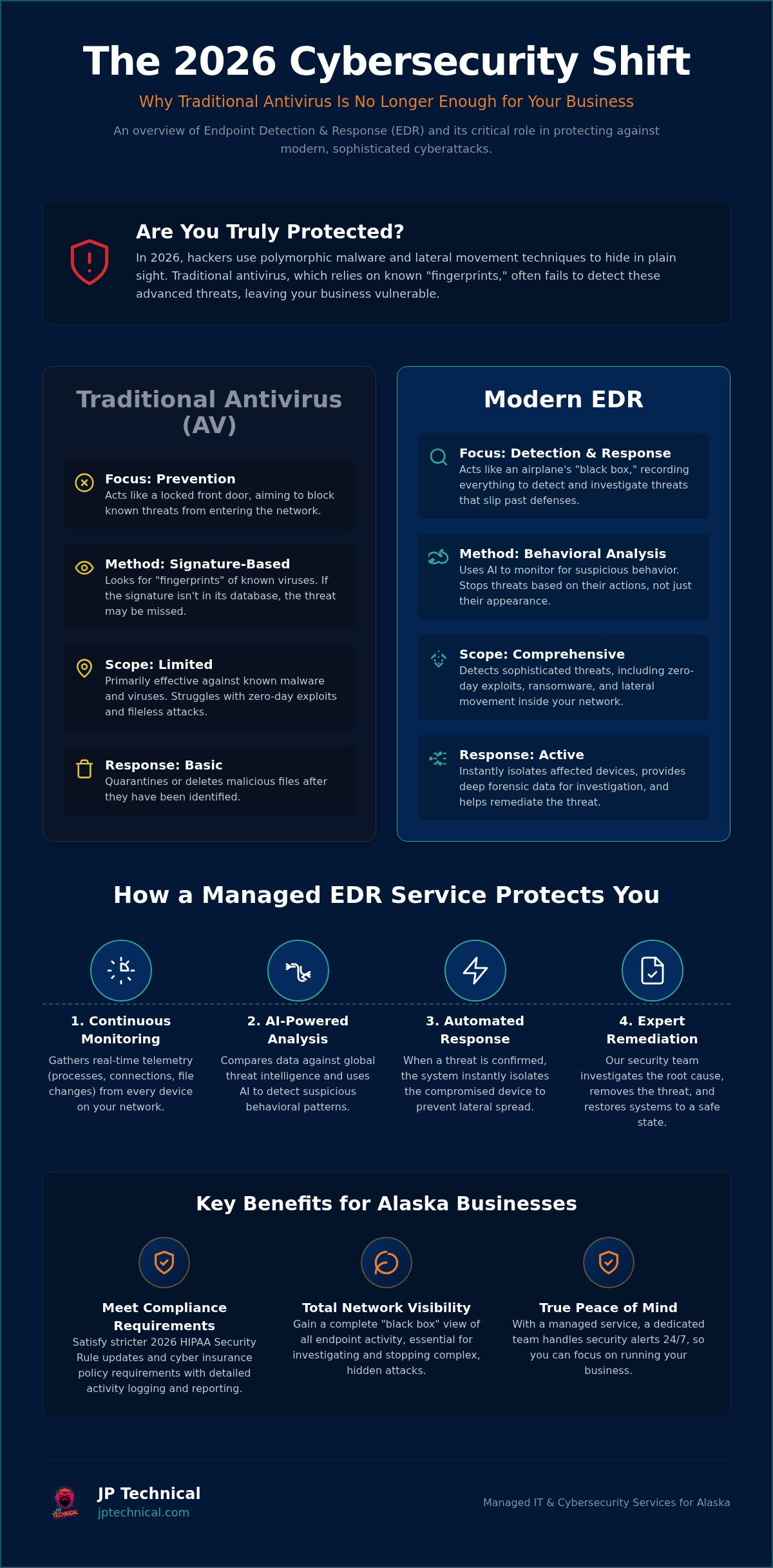
In the past, security was mostly about keeping the bad guys out. You’d install a firewall and some antivirus software, then hope for the best. But in 2026, that’s like locking your front door and assuming no one can ever climb through a window. Endpoint detection and response (EDR) is a modern security layer that doesn’t just watch the door; it records and analyzes every single action happening on your devices to catch threats that have already managed to slip inside.
Think of it like an airplane’s “black box” flight recorder. If a plane experiences a problem, investigators use the black box to see exactly what happened leading up to the event. EDR does the same for your servers, desktops, and mobile devices. It tracks every process, file change, and network connection. This allows us to investigate exactly how a breach started and what the intruder tried to touch. This shift from simple prevention to active detection is what keeps local operations running when traditional tools fail.
The “services” part of endpoint detection and response services is where the real value lies for Alaska business owners. Software alone will only send you an alert, often at 2:00 AM on a Saturday. A managed service means a professional team is actually watching those alerts, responding to them, and cleaning up the mess so you don’t have to be a cybersecurity expert yourself. It’s the difference between having a burglar alarm that just makes noise and having a security guard who actually shows up to stop the intruder.
The Core Components of Managed EDR
A reliable security setup isn’t just one tool; it’s a combination of vigilance and technology. Managed EDR provides a level of oversight that most small in-house teams can’t maintain alone. It includes:
Continuous Monitoring: We keep a watchful eye on every device in your network, from your Anchorage headquarters to remote laptops in Fairbanks or Wasilla.
Behavioral Analysis: Instead of looking for known “signatures,” we look for suspicious behavior. If a file starts acting like it’s trying to encrypt your data, EDR stops it even if it’s a brand-new threat.
Automated Response: If a threat is detected, the system can instantly isolate that specific device from the rest of your network to prevent the infection from spreading across your office.
Why 2026 Demands More Than Antivirus
Hackers now use polymorphic malware, which is software that changes its own code to avoid being recognized by traditional antivirus. These threats don’t have a “fingerprint” for old scanners to find. Modern endpoint detection and response services are designed to detect lateral movement, which is when an intruder tries to hop from one computer to another inside your local network. EDR serves as the essential bridge between detecting a silent intruder and launching an immediate response to protect your business.
How Endpoint Detection and Response Works: A Proactive Approach
Endpoint detection and response services don’t just sit quietly waiting for a virus to appear. Instead, they operate as a continuous cycle of observation and action. The process begins with gathering telemetry from every device in your network. Whether your team is working in an Anchorage office or logging in remotely from Fairbanks, the system records system calls, process starts, and network connections in real time. This raw data provides the visibility needed to understand exactly what’s happening across your entire infrastructure.
This collected data is then compared against global threat intelligence databases. By aligning your defense with the Cybersecurity Performance Goals established by CISA, we ensure your business meets high standards for digital resilience. If a file or a specific behavior matches a known threat pattern, the system flags it immediately. We don’t just look for a “bad file”; we look for the footprints of an intruder who might be trying to hide.
Once an alert triggers, the investigation phase begins. We analyze the root cause to see how the threat entered your system. This might reveal a phished password or an unpatched piece of software. Finally, remediation allows us to roll back any unauthorized changes. We can return your system to a safe state without needing a full manual rebuild, which keeps your local operations running with minimal downtime.
The Role of AI and Machine Learning
Modern threats move too fast for manual detection alone. AI and machine learning analyze behavioral patterns to predict malicious intent. If a process starts acting like ransomware by trying to encrypt files, the system responds in milliseconds. This speed is vital for stopping an infection before it spreads to other workstations. This technology also helps filter out harmless system updates, which reduces alert fatigue and ensures that only real threats get the attention they deserve.
Human Oversight: The SOC Advantage
Even the most advanced AI can’t replace the intuition of a seasoned professional. Our managed services include human oversight through a Security Operations Center (SOC). These experts validate complex threats and conduct proactive threat hunting. They look for hidden vulnerabilities that automated tools might miss. This provides your business with 24/7 vigilance without the high cost of hiring a full-time in-house security team. If you’re concerned about your current level of protection, you can request a free IT assessment to identify any gaps in your defense.
EDR vs. Antivirus: Understanding the 2026 Security Gap
Traditional antivirus software acts like a sturdy lock on your office door. It’s great for keeping out casual intruders and blocking known threats that have been seen before. However, modern hackers don’t just walk up to the front door. They find unlatched windows or pick the lock with sophisticated tools. If a thief gets inside, a simple lock can’t help you anymore. This is where endpoint detection and response services change the game. Instead of just a lock, EDR provides a 24/7 security camera and a guard who watches the feed, ready to act the moment someone suspicious enters the building.
The gap between these two technologies comes down to visibility and intent. Traditional antivirus is reactive. It waits for a file to match a known database of “bad” signatures before it takes action. If a hacker uses a zero-day exploit or a “fileless” attack, the antivirus won’t see anything wrong. EDR doesn’t just look at what a file is; it looks at what the file is doing. This behavioral approach is so critical that it’s a key pillar of the Executive Order on Improving the Nation’s Cybersecurity. When an incident occurs, EDR doesn’t just tell you a file was deleted. It shows you exactly where the threat originated, how it moved through your network, and what other systems it tried to touch.
Comparing Capabilities: AV vs. EDR
For most Alaska businesses, a multi-layered defense strategy is the most reliable approach. You don’t necessarily replace your antivirus; you augment it with a more capable detection layer. This ensures that the “noise” of common viruses is handled while your team stays focused on advanced threats.
Antivirus (Prevention): Focuses on stopping known threats using signature-based detection. It’s a passive layer of defense.
EDR (Detection/Response): Uses behavioral analysis to find unknown threats and provides tools for active investigation and device isolation.
MDR (Managed Services): Combines EDR technology with 24/7 human oversight to handle alerts and remediation on your behalf.
Why Managed EDR is the Gold Standard
Moving from a reactive “break-fix” IT model to a proactive security stance is no longer a luxury. It’s a necessity for business continuity. One of the biggest risks businesses face is “dwell time,” which is the period a hacker spends inside your network before being caught. Without advanced tools, this can last for months. Managed endpoint detection and response services reduce that window from months to minutes by catching suspicious movements instantly. By partnering with experts who provide managed cybersecurity Anchorage businesses can trust, you ensure that your defense is always active, even when your office is closed for the night. This steady vigilance is what ultimately prevents a minor alert from turning into a full-scale ransomware disaster.
Compliance and Business Continuity: The HIPAA Connection
For medical practices and professional firms across Alaska, the conversation around cybersecurity often centers on one thing: compliance. Failing to meet HIPAA standards isn’t just a technical oversight; it’s a direct risk to your entire operation. In 2026, the updated HIPAA Security Rule has introduced more stringent requirements, specifically mandating behavioral-based endpoint detection and response services on all endpoints. This shift moves beyond traditional antivirus to ensure that every device handling electronic Protected Health Information (ePHI) is monitored for suspicious activity at all times.
The cost of a breach for a local practice goes far beyond the initial cleanup. You face federal fines, devastating reputation damage within our close-knit communities, and significant operational downtime. If your office can’t access patient records for several days, your revenue stops, but your overhead doesn’t. Additionally, cyber insurance carriers have become much stricter. Most now require proof of EDR implementation before they’ll even consider a policy application or renewal. Maintaining these services is no longer a luxury; it’s a prerequisite for business continuity and insurance eligibility.
Meeting HIPAA Standards with Managed EDR
Auditors look for a clear trail of evidence. Managed EDR provides the log retention and reporting necessary to prove you’ve been vigilant. If a breach is attempted, the system doesn’t just block it; it creates a detailed record of the event. By using HIPAA compliant IT services Anchorage practices can rely on, you gain the ability to isolate infected devices instantly. This prevents unauthorized access to the rest of your network and ensures that ePHI remains secure and encrypted, even if one workstation is compromised.
Protecting the Local Alaska Professional Practice
Consider the impact of a ransomware attack on a local clinic in Wasilla or Kenai. Without advanced protection, an employee clicking a single bad link could encrypt every patient file in minutes. With EDR, the system identifies the encryption behavior and shuts down the process before it can spread. Implementing EDR helps shield business owners from the legal and financial fallout of a data breach by providing a documented, proactive defense that meets the “reasonable care” standard required by law. Working with a local partner means you have a real person to call when questions arise, ensuring your practice remains both compliant and operational. Get your free HIPAA-compliant IT assessment today.
Choosing the Right EDR Service Provider in Alaska
Selecting a partner for your cybersecurity isn’t just about picking the most famous software brand. For businesses in Anchorage, Wasilla, or Fairbanks, it’s about finding a team that understands the unique operational challenges of the North. Global providers often treat local firms like a ticket number in a massive queue. They don’t know your community, and they certainly don’t understand the local business culture. Choosing a local guardian ensures that when a critical alert triggers, you’re supported by experts who are invested in the success of your specific region.
The most important decision you’ll make is whether to handle these tools yourself or opt for a managed solution. While some vendors sell standalone software, most small teams lack the time to monitor alerts around the clock. If you buy the software but nobody is watching the dashboard, the protection is incomplete. Managed endpoint detection and response services bridge this gap. At JP Technical, we’ve acted as a local IT guardian since 1996. With 30 years of experience, we provide the technical mastery to handle threats quietly in the background so you can focus on your daily operations.
What to Look for in an EDR Partner
When you interview a potential IT provider about their security stack, you need to look beyond the sales pitch. A reliable partner should offer more than just a monthly invoice. Look for these specific capabilities:
24/7 Monitoring: Cyberattacks don’t follow a 9-to-5 schedule. Your provider must offer rapid incident response at any hour.
System Integration: Your security tools should work seamlessly with your existing managed IT and backup systems to ensure no data is left unprotected.
Transparent Reporting: You deserve to know what’s happening on your network. Your partner should provide reports that make sense to business owners, not just IT specialists.
Getting Started with a Security Assessment
The first step toward true peace of mind is identifying the invisible gaps in your current defense. Many Alaska business owners assume they’re protected until an audit or an insurance application proves otherwise. A professional security assessment is the only way to ensure you meet the latest HIPAA compliance standards and insurance requirements. We look at your servers, desktops, and mobile devices to find where an intruder might find a way in. Don’t wait for a breach to discover your vulnerabilities. You can schedule your free IT assessment today to secure your endpoints and protect your local practice for the long term.
Securing Your Alaska Business for the Future
Protecting your network in 2026 requires more than just a locked digital door. It requires the constant vigilance that only endpoint detection and response services can provide. By moving beyond traditional antivirus, you ensure that your local operations stay online while meeting the strict demands of HIPAA audits and modern cyber insurance carriers. This proactive approach closes the security gap and gives you the total network visibility needed to stop advanced threats before they cause damage.
JP Technical has served as a reliable local guardian for Alaska businesses since 1996. As HIPAA-compliant security specialists, we provide the technical mastery needed to handle complex alerts quietly in the background. Whether your office is in Anchorage, Wasilla, or Fairbanks, you don’t have to face these regulatory or technical hurdles alone. We value human connection and provide the steady, local accountability that distant vendors simply can’t match. Secure Your Business with a Free IT Assessment Take the first step toward a more predictable and secure future for your practice. We’re ready to show up when things get difficult and act as your dedicated ally in the fight against cyber threats. Peace of mind is possible when you have the right partner watching over your endpoints.
Frequently Asked Questions
Is EDR the same as antivirus software?
No, EDR is not the same as traditional antivirus. Standard antivirus software relies on a database of known threats to block files. If a hacker uses a new, unknown “zero-day” exploit, the antivirus won’t recognize it. Endpoint detection and response services look for suspicious behaviors instead of just file names. This allows the system to catch intruders who are already inside your network, providing a much higher level of protection for your Alaska office.
Does my small business really need EDR if we use cloud storage?
Yes, your business still needs protection even if you store everything in the cloud. Cloud storage protects the data at rest, but hackers use your local computers as the gateway to reach those cloud accounts. If an employee in Wasilla or Fairbanks accidentally installs malware on their laptop, that software can steal cloud credentials or sync encrypted files back to your storage. EDR protects the entry point where your team actually interacts with the data.
How much do endpoint detection and response services cost?
The cost for endpoint detection and response services typically depends on the number of devices you need to protect and whether you choose a fully managed service. While we don’t provide flat pricing here, it’s helpful to view this as a proactive investment in business continuity. Avoiding a single ransomware event or HIPAA fine often covers the cost of the service for years. Most local businesses find that the managed model is the most cost-effective way to gain 24/7 expert oversight.
Can EDR prevent ransomware from encrypting my files?
Yes, EDR is specifically designed to stop ransomware in its tracks. Unlike old tools that wait for a virus signature, EDR watches for the specific behavior of file encryption. If a program starts rapidly locking files on your computer, the system identifies this as a threat. It instantly kills the malicious process and can even isolate the infected device from the rest of your Anchorage network to prevent the ransomware from spreading to other workstations.
Will EDR slow down my employees’ computers or laptops?
Modern EDR solutions are designed to be extremely lightweight and shouldn’t noticeably impact your team’s productivity. Older security tools often ran heavy scans that drained system resources, but modern protection software performs most of its complex analysis in the cloud. This means your employees in Kenai or Palmer can continue their work without experiencing the lag or “freezing” often associated with legacy antivirus products.
How does EDR help with HIPAA compliance for my medical practice?
EDR helps you meet the 2026 HIPAA Security Rule updates by providing the required behavioral-based monitoring for all endpoints. It creates a detailed audit trail of every action taken on devices that access patient records. If a breach is attempted, you’ll have the “proof of vigilance” needed for an audit. This level of protection ensures that ePHI remains secure and that your practice meets the “reasonable care” standards required by federal law.
What is the difference between EDR and Managed EDR?
EDR refers to the software tool itself, while Managed EDR includes a team of experts who monitor that tool for you. If you only have the software, your own staff must investigate every alert, even at 3:00 AM. With Managed EDR from a local partner like JP Technical, our Security Operations Center handles the analysis and response. We filter out false alarms and only involve you when a real decision is needed for your business.
Can EDR detect threats on mobile devices and remote laptops?
Yes, EDR is built to protect devices no matter where they’re located. Whether your employees are working from a home office in Fairbanks or using a mobile device on a job site in Anchorage, the security agent stays active. As long as the device has an internet connection, it sends telemetry back to the central system. This ensures that remote laptops don’t become a weak link in your company’s overall security posture.
 Article by
Colter Hobbs