Anchorage Business Key Card Entry: 2026 Security Guide
Imagine standing outside your office in sub-zero temperatures, only to have a physical key snap off in a frozen lock or realize a former employee still has a master key. For many local owners, these moments aren’t just inconveniences; they’re immediate threats to business continuity and safety. Securing your facility shouldn’t feel like a constant battle against hardware failure and administrative overhead. When you implement a professional key card entry system for business Anchorage operations, you replace the manual burden of rekeying locks with a streamlined, digital solution that works as hard as you do.
We know you need a security setup that remains reliable whether it’s mid-July or the dead of a record-breaking Alaska winter. You deserve the peace of mind that comes from a system that integrates seamlessly with your IT infrastructure while meeting strict HIPAA or local industry standards. This guide will show you how to achieve that “set it and forget it” level of protection. We’ll cover the latest Title 23 building code updates, hardware durability requirements, and the benefits of managing multiple locations from a single remote dashboard.
Key Takeaways
Identify the specific hardware ratings required to keep your readers and locks operational when temperatures drop to -40°F.
Discover how a modern key card entry system for business Anchorage facilities ends the expensive cycle of rekeying locks every time an employee leaves the company.
Learn how to leverage your existing IT infrastructure to manage door access remotely across multiple buildings or office suites.
Navigate the critical differences between fail-safe and fail-secure hardware to maintain compliance with Anchorage municipal fire codes.
Streamline your regulatory audits by using automated access logs to satisfy HIPAA requirements for physical facility safeguards.
Table of Contents
Why Anchorage Businesses are Swapping Keys for Card Access
For decades, a heavy ring of brass keys was the standard for Anchorage business owners. If an employee left the company or a key went missing, the solution was always the same: call a locksmith, wait for an appointment, and pay to have every exterior cylinder rekeyed. This manual process is no longer sustainable for modern operations. A key card entry system for business Anchorage facilities transforms security from a mechanical chore into a networked IT asset. Instead of relying on physical ridges in metal, these systems use encrypted digital credentials to grant or deny access instantly.
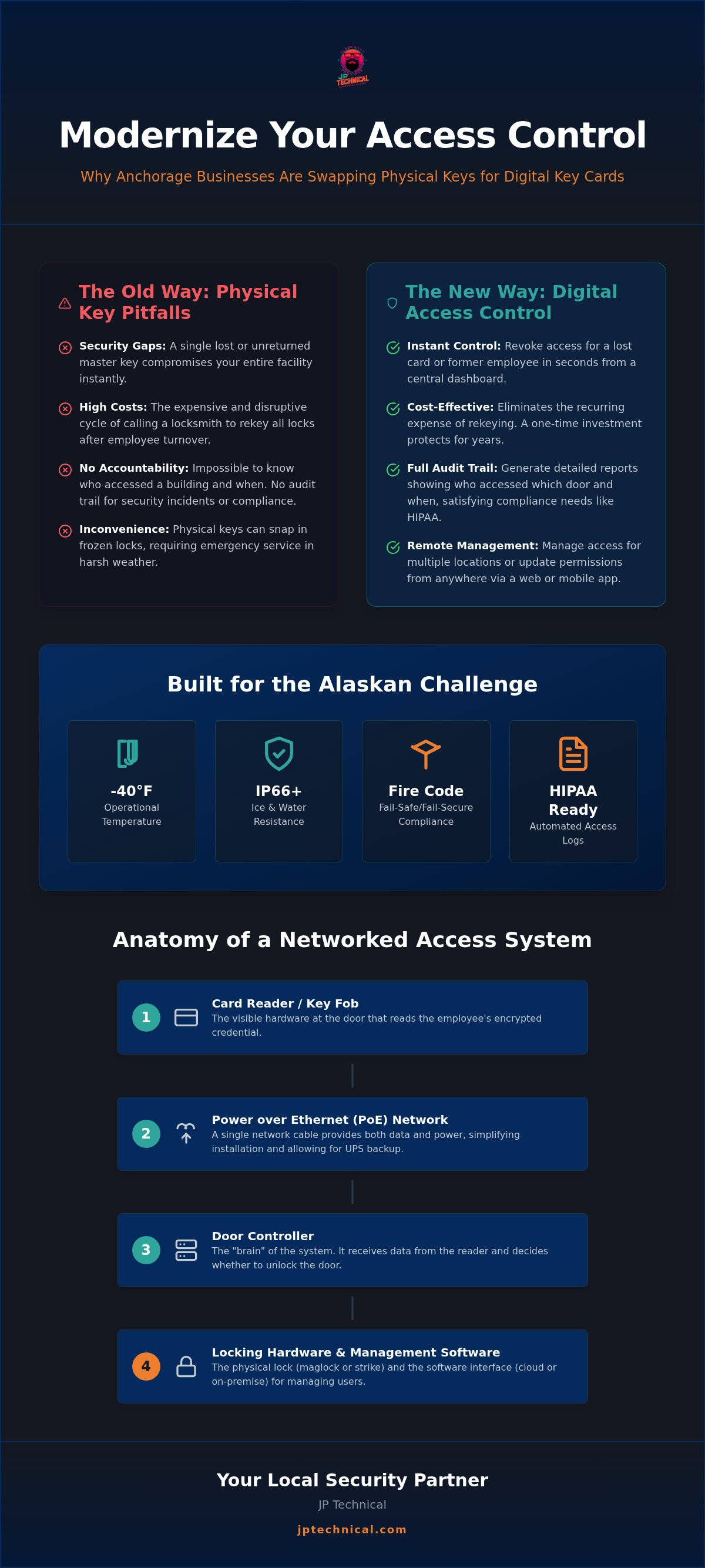
The primary advantage of moving to a networked solution is the elimination of the “master key nightmare.” When you rely on traditional locks, a single lost master key compromises the entire building’s integrity. In contrast, a digital system allows you to revoke a specific credential in seconds through a central management interface. This proactive approach ensures that your facility remains secure without the “hidden tax” of repeated locksmith visits and hardware replacements. By integrating physical security with your existing network, your doors become intelligent data points that provide real-time visibility into your operations.
The Administrative Burden of Traditional Locks
Traditional lock-and-key setups create a significant administrative drag. Every time there is employee turnover, you face a choice between spending money on rekeying or gambling on the hope that no unauthorized copies of the key exist. In a close-knit community like Anchorage, the risk of “lost” keys circulating is high. Physical keys are often the weakest link in a security plan because they provide no accountability. If a door is unlocked at 2:00 AM, a standard deadbolt cannot tell you who was responsible. Transitioning to a digital system removes this uncertainty and replaces it with a permanent, searchable audit trail.
Key Cards vs. Keyless Entry: What’s the Difference?
It is helpful to distinguish between standalone “keyless” entry and a fully integrated key card entry system for business Anchorage deployments. Standalone keypads often use a single code shared by everyone, which fails to provide individual accountability. Professional systems utilize Radio Frequency Identification (RFID) technology. This allows each employee to carry a unique card or fob that the reader identifies. The Anatomy of a Networked Access Control System involves these readers communicating back to a central controller. If an employee is promoted or changes departments, you can update their access levels across multiple doors or locations with a few clicks. This flexibility is essential for high-traffic environments where security needs change daily.
The Anatomy of a Networked Access Control System
A professional key card entry system for business Anchorage installations consists of several critical components that work in unison to protect your perimeter. The most visible part is the card reader. In our local climate, choosing hardware with an IP66 or higher rating is essential. These readers must withstand heavy ice buildup and temperatures that frequently drop below -40°F without the internal electronics becoming brittle or failing. Behind the scenes, the door controller acts as the “brain.” This device sits on your internal network and makes the final decision to engage or disengage the lock based on the credentials it receives.
Modern systems utilize Power over Ethernet (PoE) to streamline installation. By using a single network cable to provide both data and power to the door hardware, we eliminate the need for complex high-voltage electrical runs at every entrance. This approach increases reliability because the entire security system can be backed up by a central Uninterruptible Power Supply (UPS) in your server room. Management software then ties everything together, allowing you to choose between on-premise servers for maximum data control or cloud-based platforms for managing multiple Anchorage locations from a single smartphone app.
Why Access Control is Now an IT Function
Security hardware no longer exists in a vacuum. Because every controller is a networked device, your entry system must be placed on a secure, isolated network segment to prevent unauthorized access. This is why having a partner who understands Managed IT Services in Anchorage is vital. Your IT provider ensures that the door software receives regular security patches and that your hardware doesn’t become a vulnerability point for your broader business network. If you aren’t sure how your current doors are partitioned on your network, a free IT assessment can help identify potential security gaps.
Integrated Security: Linking Cards to Cameras
The true power of a key card entry system for business Anchorage comes from integration. By linking your card readers to your surveillance system, you enable “video verification.” When a card is swiped, the system automatically tags the relevant video clip. This allows you to confirm that the person using the card is actually the authorized employee and not someone who found a lost fob. This level of oversight significantly reduces false alarms and minimizes the need for dedicated security staff to monitor doors manually. For a deeper look at how to pair these technologies, see our guide on Commercial Security Camera Installation Anchorage.
Anchorage-Specific Challenges: Weather, Codes, and Durability
Anchorage presents a unique set of operational hurdles that national security vendors often overlook. Selecting a key card entry system for business Anchorage deployments requires more than just picking a reputable brand; it demands hardware that can survive the specific thermal stresses of the Alaska Interior. From the Port of Anchorage to business parks in South Anchorage, local infrastructure must remain resilient against both environmental extremes and evolving municipal regulations. Relying on generic solutions often leads to hardware failure exactly when you need protection the most.
Alaska Weather and Hardware Reliability
Consumer-grade smart locks frequently fail when exposed to the moisture and extreme cold of an Alaska winter. Internal batteries die prematurely in the cold, and moving parts often seize when standard lubricants thicken in sub-zero temperatures. Professional-grade electric strikes and magnetic locks are necessary to ensure consistent operation. We define Alaska-rated hardware as equipment tested for extreme thermal cycles, ensuring that mechanical expansion and contraction don’t lead to jams. If your hardware isn’t specifically rated for -40°F and heavy ice buildup, your security system becomes a liability the moment the first cold snap hits.
Local Compliance and Permitting
Installing a key card entry system for business Anchorage facilities involves more than just mounting a reader on a wall. On May 18, 2026, the Municipality of Anchorage implemented significant updates to Title 23 of the municipal building code. These changes align local standards with the 2021 International Fire Code (IFC). To pass a fire marshal’s inspection, your system must correctly balance security with life safety. Professional installation is mandatory because your access control must interface correctly with the building’s fire alarm system.
Fail-Safe vs. Fail-Secure: Fire codes often mandate that certain doors “fail-safe,” meaning they unlock automatically during a fire alarm to allow for emergency egress.
ADA Compliance: Card readers and intercoms must be mounted at specific heights and locations to ensure they are accessible to all employees and visitors.
Local Accountability: Using a local provider ensures that your system meets the specific interpretations of the Anchorage Fire Department, preventing costly rework after an inspection.
Working with a local partner provides a “boots on the ground” advantage that remote providers can’t match. Whether your facility is in Anchorage, Wasilla, or the Kenai Peninsula, having a technician who can be on-site quickly is vital for long-term maintenance. We understand the local infrastructure because we’ve been part of this community since 1996. This deep experience allows us to navigate local permitting and compliance hurdles efficiently, keeping your project on schedule and your building safe.
Justifying the Investment: ROI and Risk Mitigation
Investing in a key card entry system for business Anchorage operations isn’t just about modernizing your doors; it’s about financial predictability. When you calculate the lifetime cost of traditional locks, the numbers favor digital solutions. Every time an employee leaves, the manual process of rekeying can cost hundreds in labor and hardware. Over several years, these recurring fees often exceed the initial investment of a networked system. By switching, you eliminate these surprise expenses and replace them with a stable, manageable asset that protects your bottom line.
Beyond the direct cost of hardware, you must consider the impact on employee productivity. Traditional keys are prone to loss, theft, or simply being left at home. Each lockout results in downtime for the employee and an administrative burden for the manager who must provide entry. Digital credentials, including smartphone-based access, ensure that your team can enter the building and start work without delay. Additionally, many insurance providers recognize the reduced risk associated with professional access control. By demonstrating that you have a monitored, logged entry system, you may qualify for lower liability premiums, further improving your return on investment.
HIPAA and Regulatory Standards for Medical Offices
In healthcare environments, security is a regulatory mandate rather than a suggestion. HIPAA requires strict physical safeguards to protect patient data and sensitive records. A card system provides an automated audit trail that manual logs simply can’t match. You can restrict access to server rooms, pharmacies, or file storage to specific personnel based on their job roles. This “Need to Know” approach is a cornerstone of compliance. If an auditor asks who accessed a sensitive area after hours, you can generate a report in seconds. Our HIPAA Compliant IT Services ensure that your physical security integrates with your broader data protection strategy.
Scalability for Growing Anchorage Businesses
As your business expands from a single office in Midtown to multiple locations across the Mat-Su Valley, your security must scale with you. Managing physical keys for three different buildings is a logistical nightmare. With a centralized portal, you can add new doors or revoke access for the entire company from one screen. This efficiency removes the need for on-site security guards at every entrance, allowing your team to focus on their primary roles. We design our Physical Security Solutions to grow alongside your business, ensuring that your initial investment remains relevant as your footprint increases. Schedule a free IT assessment to evaluate your security ROI
The JP Technical Approach: Your Local Security Guardian
Choosing a security provider in Alaska requires more than just looking at a product catalog. It requires a partner who understands the specific demands of our local infrastructure. Since our founding in 1996, we have spent 30 years protecting the businesses that keep Anchorage running. We don’t just ship boxes of hardware; we provide a steady, reliable presence that national vendors simply cannot match. When you implement a key card entry system for business Anchorage operations through us, you are gaining a guardian that remains vigilant long after the initial installation is complete.
Our background as a Managed IT provider allows us to treat your physical security with the same technical rigor as your digital data. We utilize proactive monitoring to ensure your system stays online. If a door controller at your facility loses its connection to the network, our team receives an alert immediately. We often begin troubleshooting the issue before you or your employees even realize there is a problem. This “straight-shooter” philosophy means we value transparency and direct communication. You get clear, upfront pricing and a security model built for long-term stability rather than a quick sale.
Our Integrated Installation Process
Moving from traditional locks to a networked system is a significant upgrade that requires careful planning. We begin with a comprehensive site survey to identify your facility’s unique vulnerabilities and traffic patterns. We then handle the complex network configuration to ensure your security hardware is properly segmented from your primary business data. We define integrated security as the convergence of digital logic and physical hardware. Once the hardware is in place, we walk your team through the management software. We make sure your administrators feel confident adding users, revoking credentials, and pulling audit reports without any technical anxiety.
Secure Your Future Today
The transition to a smarter security model starts with identifying where your current defenses are failing. Whether you are struggling with the high cost of rekeying or a lack of visibility into after-hours access, a professional assessment is the first step toward a more predictable environment. We help you move away from vulnerable, mechanical keys and toward a secure, IT-managed perimeter that scales with your growth. Our goal is to provide the peace of mind that comes from knowing your facility is protected by experts who live and work in your community. Request your Free IT and Security Assessment
Secure Your Anchorage Facility for the Long Term
Securing your building in Alaska requires a strategy that accounts for both technical precision and environmental extremes. You have seen how selecting a professional key card entry system for business Anchorage operations eliminates the persistent administrative burden of rekeying locks while ensuring your hardware survives sub-zero temperatures. Balancing these needs with the latest Title 23 building code updates is essential for maintaining a safe, compliant workplace.
Our team has been on the ground in Anchorage since 1996. We understand that security isn’t just about a lock; it’s about the entire network supporting it. By integrating HIPAA-compliant protocols with proactive physical security, we ensure your facility remains a stable asset. We are here to act as your local guardian, handling the technical hurdles so you can focus on your business. Get a Free IT & Security Assessment for Your Anchorage Business Take the first step toward a more predictable and secure future for your team. We look forward to helping you build a system that works reliably every day of the year.
Frequently Asked Questions
Is it cheaper to use key cards or a traditional locksmith in the long run?
Key cards are significantly more cost-effective over time. While the initial hardware installation requires an upfront investment, you eliminate the recurring expenses of locksmith visits for rekeying. When an employee leaves, you simply deactivate their digital credential in the software. This “set it and forget it” approach saves substantial administrative time and money compared to managing mechanical keys and physical lock cylinders.
Will my key card system still work if the building’s internet goes down?
Yes, professional access control systems continue to function during an internet outage. The local door controllers store a database of authorized users and access rules. While you might lose remote management capabilities or real-time logging until the connection is restored, the doors will still lock and unlock for valid credentials. This ensures your business remains secure and accessible even during local ISP disruptions.
Can I use my smartphone instead of a physical key card?
Most modern systems allow for smartphone-based access using Bluetooth or NFC technology. This is often more convenient for employees and reduces the cost of purchasing physical cards. You can issue or revoke digital credentials instantly through a management portal. This flexibility is a hallmark of a modern key card entry system for business Anchorage operations looking to modernize their daily workflow.
What is the best key card system for a small medical practice in Anchorage?
A networked system that provides detailed audit logs is the best choice for medical practices. HIPAA requires strict physical safeguards for patient data, so you need a system that tracks exactly who enters sensitive areas like file rooms or pharmacies. We recommend integrated solutions that combine access control with your existing IT infrastructure to ensure compliance and data security are managed seamlessly.
How do I ensure my key card system meets Anchorage fire codes?
You must ensure your hardware is configured for proper emergency egress according to Title 23 of the municipal code. This usually involves connecting the access control system to your building’s fire alarm panel. Doors in the path of travel must unlock automatically during an alarm. Working with a local professional who understands Municipality of Anchorage requirements is the only reliable way to pass a fire marshal’s inspection.
Do I need to hire an IT person to manage the key card software?
No, you don’t need a dedicated staff member if you partner with a managed service provider. We handle the software updates, database backups, and network security for your door controllers. This allows your team to focus on their actual work while we manage the technical background. If you have an existing IT team, we provide the training they need to handle basic user administration efficiently.
Can I integrate my existing security cameras with a new key card system?
Integration is possible if your cameras and access control hardware support the same communication protocols. Linking these systems allows for video verification, where swiping a card triggers a camera to record a specific clip. This provides visual proof of who is entering your building. We specialize in these integrated setups to give Anchorage businesses a comprehensive and unified view of their security posture.
How long does it take to install a key card system for a 3-door office?
A typical three-door installation takes approximately two to three business days to complete. This timeline includes running the low-voltage wiring, mounting the readers and strikes, and configuring the software on your network. We also include time for testing every component and training your staff. Every project starts with a site survey to ensure we meet the specific architectural needs of your key card entry system for business Anchorage deployment.
 Article by
Colter Hobbs