The 2026 Guide to the Cost of Managed IT Services in Alaska
Paying for IT support only when something breaks is often the most expensive way to run a business in the Last Frontier. While a reactive “break-fix” model seems cheaper on paper, the true cost of managed IT services in Alaska is often far lower than the price of unplanned downtime, which can cost small businesses hundreds of dollars per minute in lost productivity. You likely already know that the Anchorage labor market makes hiring an in-house IT specialist difficult; fully loaded costs for a single manager can range from $95,000 to $140,000 annually. It’s frustrating to face unpredictable invoices when all you want is a stable, secure network that keeps you compliant.
This guide provides a transparent look at how to budget for technology in 2026. We’ll help you move past the anxiety of HIPAA non-compliance and “out-of-state lag” by explaining how local providers structure their pricing models. You will discover how to secure a predictable monthly spend that covers everything from remote support to physical surveillance. We’ll also examine the local factors that influence your contract, ensuring you get the vigilance your business deserves without the hidden fees that often plague standard agreements.
Key Takeaways
Learn the differences between per-user and per-device pricing models to determine which structure fits your shared workstation or multi-device environment best.
Understand how geography and shipping logistics influence the cost of managed IT services in Alaska compared to national averages.
Identify the hidden financial risks of the “break-fix” model, where reactive repairs and unplanned downtime can quickly exceed the price of a stable monthly contract.
See how bundling managed IT with HIPAA compliance and physical security creates a more predictable budget while protecting your practice from regulatory fines.
Table of Contents
Understanding Managed IT Pricing in the Alaska Market
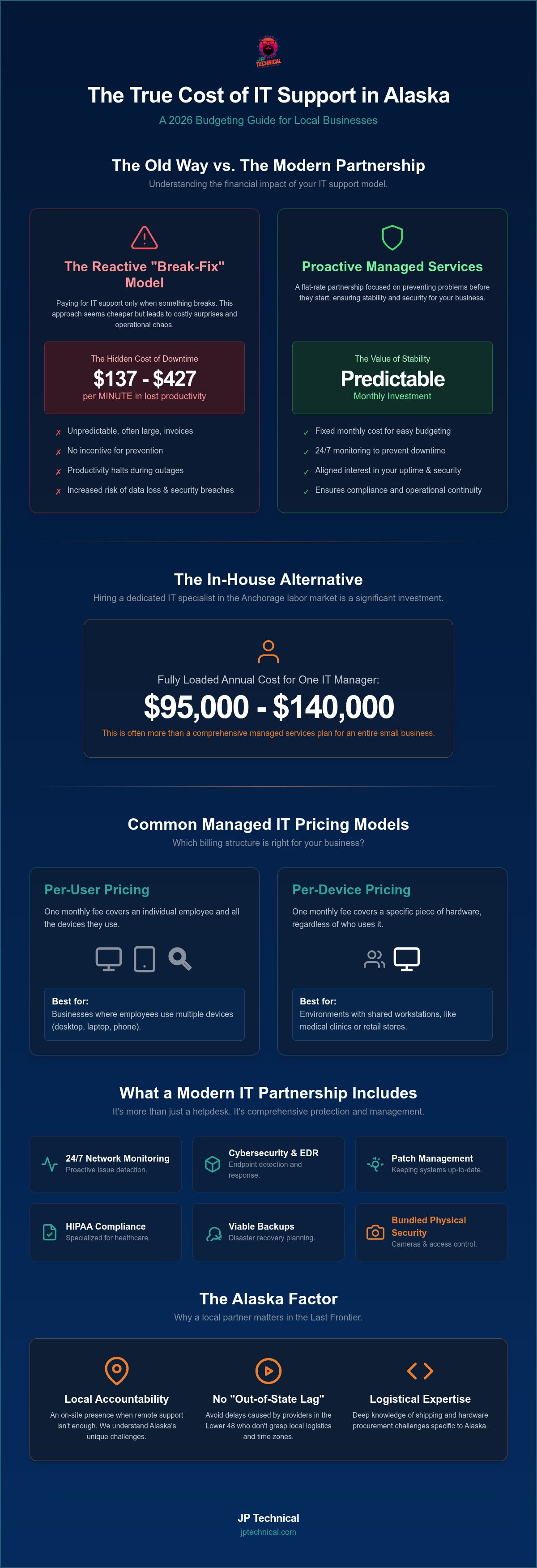
The business technology environment has fundamentally changed over the last few years. In 2026, professional IT support is no longer just a helpdesk you call when a computer won’t start. Modern Managed services represent a comprehensive partnership where a provider takes full responsibility for the health, safety, and performance of your entire network. This shift from a reactive “break-fix” model to a proactive managed approach is driven by the need for stability. For an Anchorage business, unplanned downtime can cost between $137 and $427 per minute in lost revenue and staff productivity. Because of these high stakes, the cost of managed IT services in Alaska is now seen as a necessary investment in operational continuity rather than an optional expense.
To better understand how these modern models impact your bottom line, watch this helpful breakdown of current IT cost structures:
What Exactly Are You Paying For?
A standard managed service agreement typically bundles several critical functions into one predictable monthly fee. This includes 24/7 network monitoring, routine maintenance, and remote support for your staff. However, the 2026 landscape requires more than just basic maintenance. Cybersecurity is now the core of any reliable contract. You aren’t just paying for “fixes”; you’re paying for a vigilant guardian that deploys EDR, manages patches, and ensures your backups are viable. For healthcare providers, HIPAA compliance services are often integrated into the agreement. This specialized care protects your practice from the devastating fines associated with data breaches, making compliance a built-in feature of your technology spend rather than a surprise cost.
The Evolution of IT Costs in 2026
Cloud-first strategies have changed how Alaska businesses allocate their budgets. Instead of massive upfront capital expenditures for on-site servers, companies now focus on manageable operational costs. This evolution is also influenced by the tightening requirements of cybersecurity insurance. Most carriers now require proof of active monitoring and multi-factor authentication before they’ll even issue a policy. This is where the cost of managed IT services in Alaska pays for itself by keeping insurance premiums manageable and preventing high-risk vulnerabilities. Furthermore, local businesses in areas like Wasilla or Fairbanks realize that remote-only support from the Lower 48 often fails when hardware issues arise. You need a partner with local accountability who understands our unique geographical challenges and can show up when things get difficult.
Common Pricing Models: Per-User vs. Per-Device
Finding the right billing structure is essential for long-term financial stability. Most providers use one of two primary frameworks to calculate the cost of managed IT services in Alaska: per-user or per-device. If your employees use multiple devices, such as a desktop, a laptop, and a tablet, the per-user model is usually the most cost-effective. It covers the individual regardless of how many screens they touch. Conversely, the per-device model works well for businesses with shared workstations, such as a medical clinic or a retail storefront. In these environments, five different people might use one computer, making it cheaper to cover the hardware rather than each person.
For businesses seeking total budget predictability, an all-inclusive flat-rate model is the gold standard. This approach prevents “nickel and diming” by bundling security, support, and maintenance into one invoice. It’s also where you can find significant IT cost savings by consolidating your digital security with physical surveillance. Instead of paying three different vendors for your network, your cameras, and your door access, a single local partner manages the entire ecosystem. If your business already has a small internal IT team, a co-managed model offers a middle ground. It provides your staff with advanced tools and backup support without replacing them entirely.
Per-User Pricing: The Standard for Modern Offices
The per-user model has become the industry standard because it scales effortlessly. As you hire new staff in Anchorage or the Mat-Su Valley, your IT costs increase in a linear, predictable way. This model typically includes your email hosting, helpdesk support, and advanced security like EDR. It’s particularly beneficial for hybrid teams. If a team member works from home one day and the office the next, their support and security follow them. This flexibility ensures that your protective perimeter remains intact no matter where your data is accessed.
Tiered Service Levels: Silver, Gold, and Platinum
Many agreements are structured in tiers to match different risk tolerances. A “Silver” tier might offer basic monitoring and 8-5 helpdesk support, while a “Platinum” tier provides 24/7/365 emergency coverage and a full security stack. Choosing the right level depends on how much downtime you can afford. If your operations must run around the clock, paying for a higher tier is a form of insurance against midnight system failures. If you aren’t sure which model fits your current infrastructure, a free IT assessment can help clarify your actual needs before you sign a contract.
The Alaska Factor: Why Local IT Costs Differ from National Averages
Operating a business in the Last Frontier involves unique logistical hurdles that national IT providers often fail to grasp. If you look at national pricing averages, you might see figures that don’t account for our local reality. The cost of managed IT services in Alaska is fundamentally shaped by geography and labor scarcity. For instance, finding and retaining a seasoned IT manager in Anchorage often requires a fully loaded salary between $95,000 and $140,000. These local labor premiums mean that an Alaska-based provider must invest more in their team to provide the vigilance your business requires. When you pay for managed services here, you’re paying for experts who understand how to keep systems running in our specific environment.
Geographic Logistics and Travel Fees
Businesses with multiple locations face specific challenges. If your headquarters is in Anchorage but you have satellite offices in Kenai or Palmer, travel logistics become a significant factor. Most local providers include travel within the Anchorage bowl as part of a standard agreement. However, they typically apply “trip charges” for sites in the Mat-Su Valley or the Kenai Peninsula to cover the time and fuel required for on-site support. Partnering with a provider that has a physical presence near these hubs reduces response times. It ensures that when a physical hardware failure occurs, you aren’t waiting for a technician to drive three hours or wait for a flight before your operations can resume.
Hardware and Supply Chain Realities
Shipping is the silent budget killer for many Alaska IT projects. In the Lower 48, “just-in-time” hardware delivery is the norm. Up here, a failed switch or server can take days or weeks to arrive if it isn’t already on the ground. A reliable local partner maintains an inventory of critical spares to ensure your business continuity isn’t at the mercy of a cargo plane schedule. By keeping critical hardware spares in a local warehouse, an MSP can bypass the multi-day shipping delays that typically paralyze Fairbanks businesses during a server failure. This proactive approach to inventory management is a core part of the cost of managed IT services in Alaska; it trades a slightly higher monthly fee for the prevention of catastrophic downtime. You aren’t just paying for the hardware, you’re paying for the peace of mind that comes with having that hardware available when you need it most.
Hidden Costs of the “Break-Fix” Model for Local Businesses
Many Alaska businesses fall into the “break-fix” trap. You only pay when a server fails or the network goes down. It seems like a sensible way to save money on the surface. In reality, this reactive approach creates “technical debt” where small, unaddressed problems accumulate over time. Eventually, these minor issues explode into a massive emergency that halts your operations. When you calculate the true cost of managed IT services in Alaska, you must include the price of these inevitable disasters and the stress they cause your team.
For an Anchorage office, downtime is a significant financial drain. Estimates for small business downtime in 2026 range from $137 to $427 per minute in lost revenue and staff productivity. If your team sits idle for three hours while waiting for a technician to arrive and troubleshoot, the costs are staggering. Reactive IT also increases the risk of permanent data loss. If your backups aren’t proactively managed and tested every day, you might find they’re corrupted or empty when you finally need them to recover from a hardware failure.
The Unpredictability of Emergency Labor Rates
Emergency labor rates represent a major financial risk for local companies. Standard reactive support in 2026 typically costs between $125 and $250 per hour for basic fixes. If a failure happens after hours or requires an emergency response, those rates can jump to $500 per hour. A single major server failure can result in an invoice that exceeds the total cost of managed IT services in Alaska for an entire year. Beyond the financial impact, the psychological stress on your management team is immense. Constant “firefighting” prevents you from focusing on your actual business goals.
In-House IT vs. Managed Services in Alaska
Hiring in-house is often the most expensive path for small to mid-sized companies. The average salary for an IT Manager in Anchorage currently ranges from $95,000 to $140,000 when you include benefits, taxes, and overhead. This also creates a “single point of failure” risk. If your one IT person gets sick, takes a vacation, or leaves the company, your business is left completely vulnerable. A managed service provider offers a team-based approach instead. You gain access to a pool of specialists who understand HIPAA compliance and advanced cybersecurity without the burden of a six-figure salary. Schedule a Free IT Assessment
Budgeting for Success: The JP Technical Approach
Planning a technology budget shouldn’t feel like a guessing game. At JP Technical, we utilize a “Straight-Shooter” pricing philosophy designed to eliminate the friction between business owners and their technology. We believe that professional support is a partnership based on transparency. When you evaluate the cost of managed IT services in Alaska, you aren’t just buying a subscription; you’re hiring a dedicated team to watch over your infrastructure. By bundling core managed services with specialized HIPAA compliance services, we ensure that medical practices and professional offices meet regulatory standards without the need for multiple, disconnected vendors.
Efficiency often comes from consolidation. Many of our partners find value in integrating physical security and surveillance directly into their IT budget. Managing your network cameras, door access, and digital firewalls through a single provider reduces administrative overhead and ensures your entire security posture is synchronized. This holistic approach prevents gaps in your defense that often occur when different companies handle your digital and physical assets. To get an accurate picture of your specific needs, a Free IT Assessment serves as the essential first step. It allows us to identify existing vulnerabilities and provide a clear roadmap for your 2026 technology spend.
A Local Partnership Built on Transparency
We’re committed to a “no-nonsense” work ethic that prioritizes predictable monthly billing. You won’t find hidden fees or surprise surcharges in our contracts. As a local guardian serving communities from Anchorage to Fairbanks, we understand that trust is built on reliability. If a system shows signs of failure, our 24/7 proactive monitoring allows us to intervene before it impacts your staff. This vigilance transforms IT from a source of stress into a stable foundation for your growth. We show up when things get difficult, providing the human connection that automated, out-of-state helpdesks simply cannot match.
Next Steps for Your 2026 IT Budget
Reviewing your current technology spend is the best way to identify waste. Look for overlapping subscriptions or expensive hourly invoices from previous “break-fix” repairs. If you’re interviewing potential partners, ask them how they handle Alaska-specific logistics and whether they offer integrated compliance support. A local provider should be able to explain exactly how they manage travel and hardware spares for your specific locations. For a more detailed look at how we structure our agreements, we invite you to visit our Managed IT Pricing page. Understanding the cost of managed IT services in Alaska today ensures you’re prepared for the technical and regulatory challenges of tomorrow.
Securing Your Technology Foundation in 2026
Transitioning from reactive repairs to a managed model provides the predictability your business needs to flourish. By accounting for the unique logistics of the Last Frontier and consolidating digital support with physical security, you eliminate the hidden fees that often drain local budgets. Since 1996, we’ve acted as a steady local guardian for businesses across Anchorage, Wasilla, Kenai, Palmer, and Fairbanks. Our specialized approach integrates HIPAA compliance and surveillance into one stable partnership; this ensures your operations remain secure without the need for multiple, disconnected vendors.
Understanding the total cost of managed IT services in Alaska allows you to move forward with confidence. You deserve a partner who understands the local labor market and the importance of having critical hardware on the ground when things get difficult. When your technology is proactively managed, it’s easier to stop worrying about technical debt and focus on serving your community. Get a Clear Picture of Your IT Costs with a Free Assessment Technology should be a silent partner that supports your success rather than a source of constant stress. We’re here to ensure your network remains secure, compliant, and ready for the future.
Frequently Asked Questions
How much do managed IT services cost per month for a small business in Alaska?
Monthly fees depend on your user count and the complexity of your network. You don’t want to guess when it’s time to budget. While national 2026 averages range from $100 to $250 per user, the final cost of managed IT services in Alaska is influenced by local travel logistics and the Anchorage labor market. Most small businesses find that a subscription model is more sustainable than paying for emergency repairs. It provides a stable baseline.
Is managed IT cheaper than hiring a full-time IT person in Anchorage?
Outsourcing is typically more cost-effective for small and mid-sized companies. An in-house IT Manager in Anchorage can cost between $95,000 and $140,000 annually when you factor in benefits and overhead. Managed services offer a team-based approach for a lower monthly investment. You’re gaining access to specialists in HIPAA and cybersecurity without the risk of a single point of failure if an employee leaves or takes a vacation. It’s a safer strategy.
What is usually included in a managed IT service agreement?
Most 2026 agreements include 24/7 network monitoring, helpdesk support, and patch management. You also receive backup and disaster recovery services to protect your data from hardware failures. To provide a complete safety net, providers often bundle EDR and antivirus software. Some agreements even integrate physical security and surveillance into the monthly fee. This ensures your office is protected both digitally and physically by a single local partner who understands our unique environment.
Do managed IT providers in Alaska charge extra for travel to places like Wasilla or Kenai?
Many providers include travel within the Anchorage bowl as part of their standard service. However, sites in the Mat-Su Valley or Kenai Peninsula often involve trip charges to account for travel time and fuel. The cost of managed IT services in Alaska remains more predictable when you choose a partner with a physical presence in multiple hubs like Fairbanks or Palmer. This local accountability ensures faster response times during hardware emergencies when remote support isn’t enough.
Are cybersecurity and HIPAA compliance included in the monthly IT cost?
These are often offered as part of a comprehensive service tier. Medical offices require specialized HIPAA compliance services to handle data encryption and regular risk assessments. Bundling these into your monthly fee ensures your practice stays ahead of regulatory changes. It’s a proactive way to lower the anxiety surrounding potential fines. Your provider acts as a vigilant guardian, managing technical hurdles so you can focus on patient care without worrying about compliance gaps.
Can I get a flat-rate IT support plan to make my budget predictable?
Flat-rate plans are designed specifically for budget predictability. This model covers your routine maintenance and remote support for a fixed monthly price. It prevents the “nickel and diming” associated with hourly billing and helps you avoid the massive invoices that follow a major system failure. If you want to eliminate the stress of fluctuating technology expenses, it’s the most reliable way to manage your 2026 IT budget. You’ll know exactly what you’re paying each month.
What is the difference between managed IT and a break-fix repair service?
Managed IT is a proactive partnership where the provider works to prevent problems. Break-fix is a reactive service where you only call for help after something stops working. The break-fix model often leads to higher long-term costs due to unplanned downtime and emergency labor fees. Managed services use constant monitoring to identify and resolve vulnerabilities quietly in the background. It ensures your business operations stay steady and predictable, which is vital for long-term stability.
How does managed IT help reduce my business insurance premiums in 2026?
Insurance carriers in 2026 are increasingly strict about cybersecurity requirements. They often demand proof of active monitoring, multi-factor authentication, and managed backups before issuing a policy. A managed provider implements these technical controls and provides the documentation needed for your application. This proactive posture demonstrates to insurers that your business is a low-risk client. It often results in more favorable premiums and more comprehensive coverage options, which saves you money in the long run.
 Article by
Colter Hobbs