Managed Firewall Services in Alaska: Proactive Network Defense for 2026
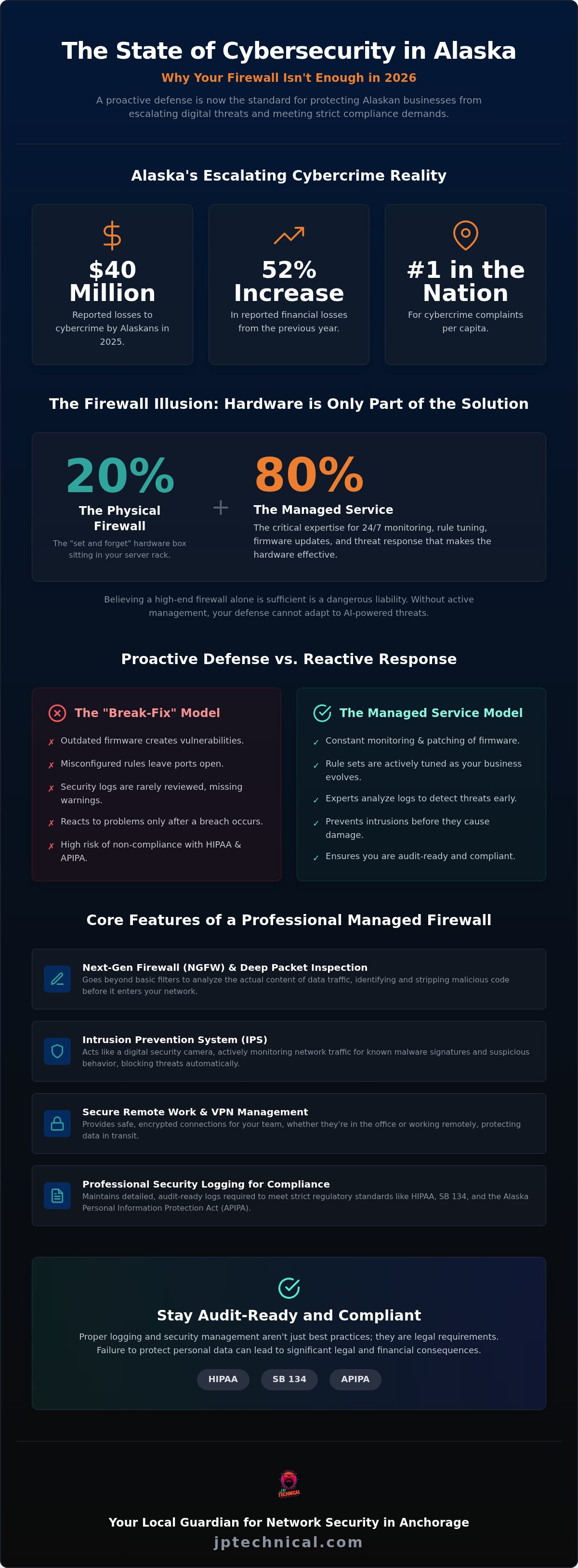
Alaskans reported nearly $40 million in losses to cybercrime in 2025, which is a 52% increase from the year before. Our state now leads the nation in cybercrime complaints per capita. It’s a sobering reality for any business owner trying to keep their operations secure while navigating the complexities of modern networking. You probably feel the pressure of hidden vulnerabilities and the technical jargon of NGFW and IPS, all while trying to meet strict HIPAA or SB 134 compliance deadlines for 2026.
Managing your own security logs and patches shouldn’t take you away from your actual work. We understand that you need a defense that’s as resilient as the landscape we live in. That’s why managed firewall services are becoming the standard for proactive network defense. Instead of a distant call center, you get a local partner who understands Alaska’s unique challenges and answers the phone when you need help.
In this article, you’ll discover how a managed approach provides the steady vigilance required to protect your business. We’ll cover how these services ensure uninterrupted operations, verify your regulatory compliance, and ultimately give you back the peace of mind to focus on growth.
Key Takeaways
Learn why hardware alone cannot stop modern threats and how managed firewall services provide the active administration required for a secure perimeter.
Understand the practical impact of Next-Generation Firewall (NGFW) features like deep packet inspection and real-time intrusion prevention on your daily operations.
Discover why a local partner in Anchorage offers a significant response-time advantage over national call centers when technical issues arise.
See how professional security logging keeps your business audit-ready for strict HIPAA and Alaska-specific regulatory standards like SB 134.
Explore the benefits of a proactive defense strategy that handles network threats quietly in the background while you focus on growing your business.
Table of Contents
What are Managed Firewall Services and Why Do They Matter?
Managed firewall services represent a fundamental shift from simply owning security hardware to partnering with experts who actively defend your network perimeter. While a traditional firewall acts as a digital gate, a managed service provides the professional guardian who stands at that gate, checks credentials, and watches for suspicious behavior around the clock. By working with a Managed Security Service Provider (MSSP), your Alaska business moves away from a reactive “break-fix” model toward a state of constant, proactive readiness.
Many business owners mistakenly believe that buying a high-end firewall is a one-time task. In 2026, this “set and forget” mentality is a liability. Cybercriminals now use AI-powered tools to scan for vulnerabilities at speeds no human can manually match. With Alaskans reporting nearly $40 million in losses to cybercrime in 2025, the stakes have never been higher. Hardware sitting in a server rack without active oversight cannot adapt to these shifting tactics. A managed service ensures your defense evolves as fast as the threats do, giving you the peace of mind to focus on growing your company rather than worrying about your network logs.
The Difference Between a Firewall and a Managed Service
The physical firewall box is only about 20% of your security solution. The remaining 80% comes from professional expertise, continuous rule tuning, and 24/7 monitoring. If your business grows or your staff begins using new cloud applications, your firewall rules must be adjusted immediately to prevent security gaps. A managed service provider handles these configuration changes quietly in the background. We identify threats before they breach your network, ensuring that your protection stays aligned with your daily operational needs without requiring your technical intervention.
Why Your Current Firewall Might Be Failing You
Outdated firmware remains a primary cause of preventable network breaches. Without regular updates, your firewall cannot recognize the latest malware signatures or exploit techniques. Additionally, misconfigured rules often leave “open” ports that act as invitations for ransomware. If you aren’t actively reviewing security logs, you’ll likely miss the early warning signs of an intrusion.
Under the Alaska Personal Information Protection Act (APIPA), failing to identify and report a breach involving personal data can lead to significant legal consequences. Proper logging is not just a security best practice; it’s a requirement for HIPAA compliance and other regulatory standards like SB 134. If you don’t have a reliable partner managing these details, your business remains vulnerable to both hackers and auditors.
Core Features of a Professional Managed Firewall Solution
A professional managed firewall solution isn’t just a single tool. It’s a suite of integrated technologies working in unison to protect your business data. While basic routers only look at the “header” of a data packet, Next-Generation Firewalls (NGFW) use deep packet inspection to look inside the traffic. This ensures that even if a file looks legitimate on the surface, any hidden malicious code is identified and stripped away before it enters your network.
In the Evolving Security Landscape of 2026, these features must be actively managed to stay effective. Static rules don’t work against dynamic threats. When you invest in managed firewall services, you’re paying for the expertise to keep these features tuned to the specific needs of your Alaska office. It’s a level of protection that hardware alone cannot provide.
Advanced Threat Protection and IPS
An Intrusion Prevention System (IPS) acts like a digital security camera for your data packets. Just as we install physical security and surveillance to watch your office perimeter, IPS monitors your network traffic for suspicious behavior. Intrusion Prevention Systems (IPS) serve as an active, automated guard that monitors network traffic to block malicious activity before it reaches your servers. It identifies known malware signatures and blocks them instantly. This proactive layer prevents ransomware from gaining a foothold in your systems.
VPN and Secure Remote Work for Alaska Teams
Modern Alaska businesses often have staff working from the field in Wasilla, Kenai, or Palmer. Without a Secure Remote Access (VPN) solution, these connections are vulnerable to interception. We integrate multi-factor authentication (MFA) directly into the firewall to ensure only authorized users can access your files. If you want to learn more about protecting your mobile workforce, you can read our guide on Secure Remote Work Solutions for Anchorage Teams.
Content filtering is the final piece of the puzzle. It protects productivity by blocking dangerous or irrelevant websites that often serve as entry points for phishing attacks. By managing these boundaries, we keep your team focused and your network clean. If you aren’t sure if your current setup includes these core features, you can schedule a free IT assessment to verify your network’s health.
Choosing a Partner: Local Accountability vs. National Providers
National providers often emphasize their global scale and massive infrastructure. While that scale sounds impressive, it frequently translates to long call center queues and a lack of “boots on the ground” when a crisis occurs in Alaska. Choosing a local specialist in Anchorage provides a level of accountability that a national firm cannot match. We understand the specific challenges our businesses face, from limited internet redundancy to the geographical hurdles that impact connectivity in places like Fairbanks, Wasilla, or the Kenai Peninsula.
When you opt for managed firewall services from a local provider, you’re investing in a “Local Guardian.” This means your security partner understands the context of your operations. We recognize the “Alaska Factor,” including the environmental risks and infrastructure limitations that can threaten your uptime. We don’t just see a generic IP address; we see a neighbor’s business that needs to stay online. If an issue arises, our response times are measured in minutes, not days spent waiting for a ticket to move through a national hierarchy.
The Value of a Steady, Reliable Partnership
A successful defense relies on human connection. It’s reassuring to know the name of the person guarding your network and to receive clear, no-nonsense communication without technical fluff. This localized approach ensures your security strategy aligns with your broader goals, such as those outlined in our guide on Managed IT Services in Anchorage. We act as a dedicated ally, handling threats quietly in the background so you can focus on your work.
Our expertise extends to helping you navigate complex federal requirements. For instance, the HIPAA Security Rule demands specific technical safeguards that must be actively maintained and documented. A local partner who specializes in these standards can verify your compliance through regular audits and steady vigilance. This prevents security gaps that often occur when using distant, automated services that don’t understand your specific regulatory environment.
Transparency and Pricing
National MSP contracts often hide extra costs behind complex tiers or “out-of-scope” service fees. We believe in a different approach. Steady reliability requires predictable costs, allowing you to stabilize your IT budget and see the direct ROI of your security investment. By linking your firewall management to overall business continuity, you transform a technical necessity into a strategic advantage. You can view our transparent pricing to see how we provide high-level sophistication with a straightforward, honest work ethic. This transparency builds the long-term trust necessary for a true security partnership in 2026.
HIPAA Compliance and Regulatory Security Standards
For Alaska medical practices, a firewall isn’t just a recommendation; it’s a legal cornerstone. HIPAA demands that covered entities implement technical safeguards to protect electronic protected health information (ePHI). Without managed firewall services, maintaining these standards becomes a full-time job that most clinics can’t afford to handle internally. By 2026, the regulatory environment is even more demanding. With the February 16, 2026, deadline for aligning HIPAA with 42 CFR Part 2, and the new requirements of SB 134, your network perimeter must be airtight.
Audit-ready logging is where many practices fall short. If a breach occurs, federal law requires a clear “paper trail” showing who accessed what and when. A professional managed solution ensures that these logs are not only captured but also stored securely and reviewed regularly. This proactive approach protects you from the heavy fines associated with the Alaska Personal Information Protection Act (APIPA) if you can’t prove your data was monitored. Data encryption is equally vital. We ensure that Patient Health Information (PHI) is encrypted while in transit, preventing unauthorized interception during remote consultations or data transfers between clinics.
Meeting Strict Healthcare Standards in Alaska
We prepare your network for a HIPAA audit by identifying every entry point into your system. One critical step we take is segmenting your network. We ensure your guest Wi-Fi is physically and logically separated from your clinical data. This prevents a patient’s smartphone in the waiting room from ever seeing your medical records. For more details on how we secure local practices, read our guide on HIPAA Compliant IT Services in Anchorage.
Continuous Compliance Monitoring
Compliance is a 365-day task, not a once-a-year checkup. Threats don’t wait for your annual audit to appear. Our team handles firewall patching and update management as part of our core service. This ensures that your regulatory standing never lapses because of an outdated piece of software. You can learn more about our HIPAA services and how we maintain a state of constant vigilance for our clients. We act as your local specialist, combining high-level sophistication with a commitment to showing up when things get difficult. Schedule your free HIPAA-focused IT assessment
JP Technical: Your Local Guardian for Network Security
Since 1996, JP Technical has served as a dedicated ally for businesses across Alaska. From our roots in Anchorage to our service in Fairbanks, Wasilla, Kenai, and Palmer, we’ve built a reputation for steady reliability and a no-nonsense work ethic. Our approach to managed firewall services is built on the idea of invisible protection. We believe that if we’re doing our job correctly, you won’t even know we’re there. We handle the complex technical mastery of threat hunting and patch management quietly in the background, allowing you to focus on your daily operations without the anxiety of a potential breach.
Choosing a local guardian means you’re partnering with a specialist who understands the unique Alaskan environment. We don’t just provide a service; we provide a human connection. When things get difficult, we’re the neighbors who show up to help. This commitment to local accountability is what sets us apart from national providers who see your business as just another ticket in a queue. We take pride in being straight-shooters who value honesty and direct communication above all else.
A Holistic View of Business Protection
We believe that true security requires a total perimeter. It’s why we emphasize the synergy between your digital network and your office’s physical environment. A firewall is the digital equivalent of the access controls we install at your front door. By integrating Physical Security and Surveillance with our network defense, we ensure that every entry point is monitored and protected. This holistic view prevents gaps that often occur when IT and physical security are managed by separate, disconnected vendors. Whether it’s a suspicious data packet or an unauthorized person at your gate, our team provides the protective vigilance you need to stay secure.
Next Steps for Your Business
Getting started with a professional defense doesn’t have to be overwhelming. We begin by helping you find the hidden gaps in your current setup. During your first 30 days of managed service, we systematically tune your firewall rules, verify your compliance standing, and establish the steady monitoring required for 2026. This transition is handled with the calm composure of seasoned professionals who have seen it all before. We move at a methodical pace to ensure your business continuity is never interrupted during the onboarding process.
If you’re ready to lower your anxiety regarding technical hurdles and regulatory pressure, it’s time for a professional review of your network. You can Get Your Free IT Assessment today to see how our team can provide the peace of mind you deserve.
Securing Your Alaskan Business for the Road Ahead
Protecting your network in 2026 requires more than just a piece of hardware; it requires constant vigilance and professional expertise. We’ve explored how managed firewall services provide a total perimeter by combining advanced threat prevention with the local accountability that national providers often lack. Whether you’re managing a medical practice that needs to stay HIPAA compliant or a growing office in Anchorage, having a reliable guardian allows you to focus on your work without technical anxiety.
JP Technical has provided boots-on-the-ground support across Alaska since 1996. We specialize in HIPAA compliance and the integration of physical and digital security to ensure your operations remain uninterrupted. Our team handles the complex patches and security logs in the background, so you always have a straight-shooter to call when questions arise. Taking a proactive step today prevents the operational hurdles of tomorrow. Secure Your Network with a Free IT Assessment You don’t have to face these technical and regulatory challenges alone. Partner with a local expert who values your business continuity as much as you do. We look forward to helping you build a stable and secure future for your team.
Frequently Asked Questions
What is the difference between a firewall and a managed firewall?
A firewall is the hardware itself, while managed firewall services include the expert administration of that device. A standard unit only follows the rules set during its initial setup. Managed services provide continuous updates, active threat hunting, and regular rule tuning. We handle the technical mastery in the background to ensure your perimeter stays current as new vulnerabilities emerge. This shift from hardware to a service provides the steady vigilance your business needs.
Do small businesses in Anchorage really need managed firewall services?
Yes, because cybercriminals don’t ignore small local shops in favor of large corporations. Smaller businesses are often targeted because they lack dedicated IT staff to manage complex security logs. With Alaska leading the nation in cybercrime reports per capita, having a professional guardian for your network is essential. Managed firewall services provide the same level of security used by larger firms but at a scale that fits your specific operational needs.
How does a managed firewall help with HIPAA compliance?
It fulfills technical safeguard requirements by providing audit-ready logging and secure data encryption. HIPAA requires you to monitor access to electronic protected health information. We configure your firewall to track every entry point and store those logs securely. If an auditor asks for proof of your security perimeter, you’ll have a verified paper trail ready. This proactive oversight is a non-negotiable part of modern healthcare standards for any medical practice.
Can a managed firewall improve my internet speed?
It can improve your effective speed by managing how your bandwidth is used. While it doesn’t change your ISP’s raw speed, it uses content filtering to block non-essential traffic like high-bandwidth streaming or social media. It also prevents hidden malware from hogging your connection. By prioritizing business-critical data, your team experiences a smoother and more predictable connection. You’ll notice better performance during video calls and large file transfers.
Is a managed firewall better than a standard antivirus?
They serve different purposes and work best as a combined defense. Antivirus is your last line of defense on individual computers. A firewall is your first line of defense at the network’s edge. It stops threats before they ever reach your devices. By blocking malicious traffic at the perimeter, you reduce the workload on your antivirus. This prevents lateral movement if one device on your network happens to be compromised. Both are necessary for total protection.
What happens if my firewall hardware fails?
We provide rapid local support to get you back online. Because we monitor your system continuously, we often detect hardware issues before you notice a slowdown. If a unit fails, our Anchorage-based team dispatches a replacement and restores your configuration from a secure backup. You won’t have to wait for a national shipping queue or spend hours on the phone with a distant call center. We prioritize your business continuity above all else.
How much do managed firewall services cost in Alaska?
Costs depend on the number of users and the specific security levels your industry requires. National data suggests small businesses often spend several hundred dollars per month for professional management and setup. We focus on providing predictable, transparent pricing that eliminates hidden fees. For an accurate quote tailored to your specific office, we recommend a professional assessment. This ensures you only pay for the level of protection your business actually needs.
Can I use a managed firewall for my remote employees in Wasilla or Kenai?
Yes, we use Secure Remote Access (VPN) to connect your field staff directly to your secure network. This ensures an employee working from home in Wasilla or Kenai has the same level of protection as someone in your Anchorage office. We integrate multi-factor authentication to verify identities, keeping your data safe even when your team is spread across the state. It’s a reliable way to maintain security for a modern, mobile workforce.
 Article by
Colter Hobbs