HIPAA Compliant IT Support in Anchorage: The 2026 Healthcare Guide
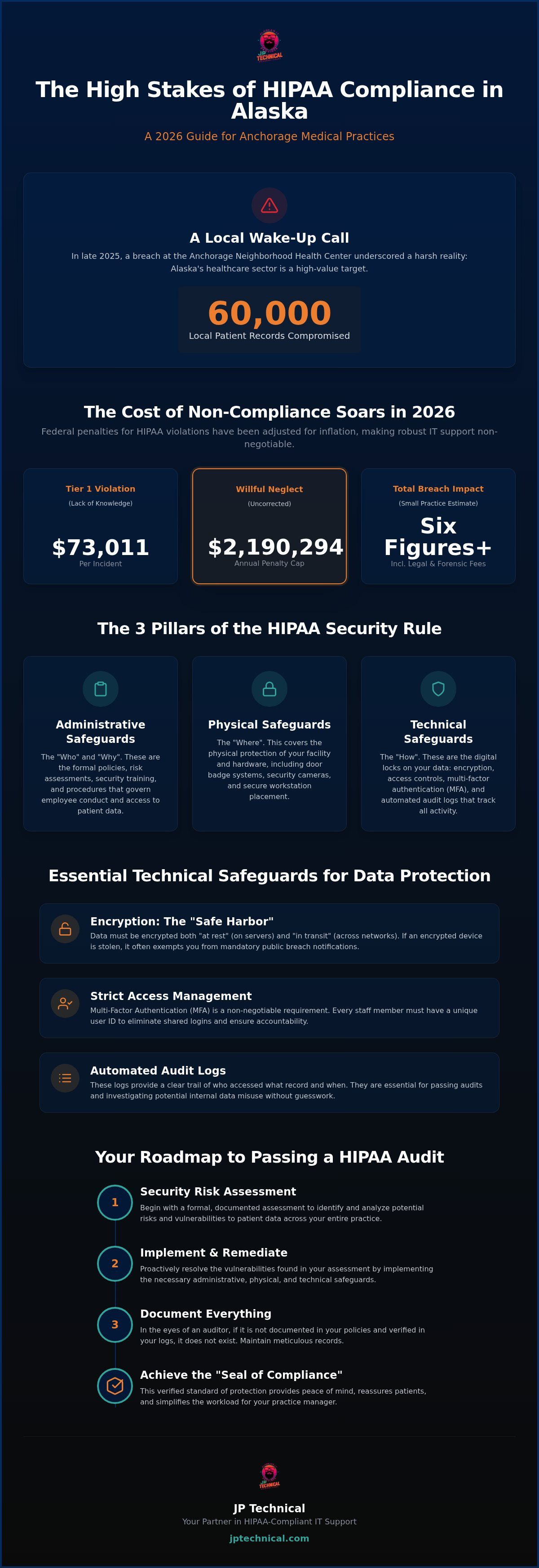
In late 2025, a hacker group targeted the Anchorage Neighborhood Health Center, compromising the records of 60,000 local patients. This event underscored a harsh reality: Alaska’s healthcare sector is a high-value target. With federal penalty caps for HIPAA violations now reaching over $2.19 million in 2026, finding reliable HIPAA compliant IT support Anchorage clinics can depend on is no longer optional. It’s the foundation of a modern medical practice.
It’s exhausting to worry about whether a single employee clicking a phishing link will trigger a federal investigation or if your clinical software will fail during a busy morning. You deserve to focus on your patients while your technology works quietly in the background. In this guide, we’ll show you how to secure your data, pass audits with the ‘Seal of Compliance’, and maintain zero-downtime operations. We will walk through the essential technical, physical, and human safeguards your practice needs to stay protected and productive in 2026.
Key Takeaways
Understand why federal mandates make HIPAA compliant IT support Anchorage a necessity for your practice and how to manage data security across remote Alaska locations.
Identify the three pillars of the HIPAA Security Rule to ensure your administrative, physical, and technical safeguards are actually protecting patient data.
Learn to bridge the gap between digital encryption and physical security by integrating door badge systems and cameras into your compliance strategy.
Follow a clear roadmap for audit preparation that begins with a formal Security Risk Assessment to identify and resolve potential vulnerabilities.
Discover how the ‘Seal of Compliance’ provides a verified standard of protection that reassures patients and simplifies the workload for your practice manager.
Table of Contents
Navigating HIPAA Compliance Challenges for Alaska Medical Practices
The HIPAA Security Rule: Technical Safeguards for Data Protection
Bridging the Gap: Physical Security and Clinical Software Support
Reliable HIPAA-Compliant IT Support in Anchorage with JP Technical
Navigating HIPAA Compliance Challenges for Alaska Medical Practices
For healthcare providers in the Far North, regulatory compliance is a federal mandate that demands constant attention. Adhering to the Health Insurance Portability and Accountability Act (HIPAA) is not a suggestion or a one-time checkbox. It is a continuous commitment to protecting patient privacy. In Anchorage, clinics face a unique set of hurdles. Many local practices rely on outdated server hardware or unsecured Wi-Fi networks that leave digital doors wide open to intruders. Relying on HIPAA compliant IT support Anchorage specialists ensures these vulnerabilities are closed before they are exploited.
Alaska also presents the “Alaska Factor” in data management. Many Anchorage-based practices operate satellite clinics in Wasilla, Kenai, or Fairbanks. Managing data security across these vast distances requires more than just a basic internet connection. It requires secure, encrypted tunnels and standardized hardware at every site. Without professional oversight, remote offices often become the weakest link in a provider’s security chain. The Office for Civil Rights (OCR) actively monitors these gaps. History shows that Alaska is not exempt from scrutiny; the Alaska Department of Health and Social Services previously agreed to a $1.7 million settlement for failing to conduct proper risk analyses and provide adequate security training.
The Cost of Non-Compliance in 2026
The financial stakes for medical practices have never been higher. As of January 2026, the Department of Health and Human Services adjusted civil monetary penalties for inflation. Tier 1 violations, which stem from a lack of knowledge, can now reach $73,011 per incident. If an auditor finds “willful neglect” that remains uncorrected, the annual cap for penalties hits a staggering $2,190,294. Beyond these fines, practices must pay for mandatory credit monitoring for victims and face a permanent loss of patient trust. Industry data suggests the total financial impact of a typical small-practice breach in 2026 can reach six figures when legal fees and forensic investigations are included.
Why ‘Good Intentions’ Aren’t Enough for HIPAA Audits
Modern auditors do not care about your intentions; they care about your documentation. The industry has shifted from reactive fixing to proactive, documented safeguarding. If a security measure is not written in your policies and verified in your logs, it does not exist in the eyes of the OCR. Partnering with a local expert for HIPAA compliance services provides the accountability needed to reduce audit anxiety. Reliable HIPAA compliant IT support Anchorage providers understand that IT performance is directly linked to clinic revenue. Every minute of system downtime is lost “chair time” for your providers, making stable technology essential for both compliance and profitability.
The HIPAA Security Rule: Technical Safeguards for Data Protection
The HIPAA Security Rule specifically governs Electronic Protected Health Information (e-PHI). It requires your practice to implement three distinct pillars: administrative, physical, and technical safeguards. While administrative policies set the rules, technical safeguards are the digital locks that enforce them. For providers seeking HIPAA compliant IT support Anchorage, these technical measures represent the most critical line of defense against modern cyber threats. Understanding how these layers work together is the first step toward a secure clinical environment.
Encryption serves as a “Safe Harbor” under federal law. If your data is encrypted to NIST standards and a device is lost or stolen, you’re often exempt from the grueling process of mandatory public breach notifications. This protection only works if your encryption covers data both at rest on your servers and in transit across your network. Additionally, automated audit logs must be active. These logs provide a clear trail of exactly who accessed what record and when they did it. This level of transparency is essential for passing audits and investigating internal errors without guesswork.
Encryption and Access Management
Securing patient data starts with strict access controls. Multi-Factor Authentication (MFA) is now a non-negotiable requirement for healthcare. It acts as a secondary barrier that stops hackers even if they manage to steal a staff member’s password. We also emphasize the use of unique user IDs for every employee. In busy clinical environments, shared logins are a common shortcut, but they destroy individual accountability. If every action is tied to a specific person, your practice remains compliant with HIPAA Security Rule Technical Safeguards.
Endpoint Detection and Response (EDR) in Healthcare
Standard antivirus software is often insufficient against modern, healthcare-targeted ransomware. These threats evolve too quickly for traditional signature-based detection to keep up. Proactive monitoring through EDR and Antivirus tools identifies suspicious behavior, such as a file suddenly attempting to encrypt thousands of others. This technology stops the threat before it ever reaches a patient record. Managed patching is another vital component. It ensures that vulnerabilities in medical imaging software or operating systems are closed before attackers can find them. If you’re unsure where your current defenses stand, you can request a professional evaluation of your practice’s security posture to identify any hidden gaps.
Bridging the Gap: Physical Security and Clinical Software Support
HIPAA isn’t just about bits and bytes; it’s about the bricks and mortar of your Anchorage office. If a server is stolen because a back door was left propped open, the best encryption won’t save you from a federal investigation. This is why HIPAA compliant IT support Anchorage clinics rely on must bridge the gap between software and the physical office. Integrating your physical security systems, like door badges and surveillance cameras, with your IT network ensures every access point is logged and monitored.
When reviewing the Official HIPAA Audit Protocol, it’s clear that physical safeguards are a major component of a successful review. Auditors specifically check if workstations are positioned to prevent “shoulder surfing” by unauthorized visitors or patients. Adding privacy screens and ensuring monitors face away from public hallways are simple but vital steps. A seasoned IT partner looks at the whole environment to protect your practice from human error and physical theft alike.
Access Control and Surveillance in the Clinic
Door badge systems do more than just unlock doors; they create a digital paper trail. Restricting access to server rooms and records closets is a fundamental HIPAA requirement. Strategic security camera placement adds another layer of protection. You need to monitor sensitive areas without infringing on patient privacy in exam rooms. These physical access logs are a mandatory part of your HIPAA documentation package and provide peace of mind that only authorized staff handle your hardware.
Seamless EHR and Imaging Software Integration
Clinical workflows depend on speed and reliability. If there’s a lag between the operatory and the front desk while using Dentrix, Eaglesoft, or other EHR platforms, patient care suffers. We focus on optimizing your local network to handle high-resolution imaging data, such as X-rays and MRIs, without slowing down your clinical software. Secure, off-site backups for this heavy data are essential for both compliance and disaster recovery. Local managed IT services provide the proactive maintenance required to keep your clinical software running at peak performance without interruption.
Preparing for a HIPAA Audit: A Proactive Roadmap
Audit readiness is not something you can achieve overnight. It requires a systematic shift from a reactive mindset to a proactive stance. Federal investigators from the Office for Civil Rights do not just look at your current firewall settings; they look at your history of vigilance. If you cannot prove you have been monitoring your systems, they will assume you haven’t been. Securing HIPAA compliant IT support Anchorage medical groups can rely on means following a proven roadmap to eliminate vulnerabilities before an auditor ever knocks on your door.
Step 1: Conduct a formal Security Risk Assessment (SRA). You must identify where your e-PHI is stored, who has access, and what threats exist. This is the first document an auditor will request.
Step 2: Develop and implement written policies. Your staff needs a clear handbook on how to handle data, report incidents, and manage passwords.
Step 3: Execute Business Associate Agreements (BAAs). You are responsible for your vendors. Every partner with access to your data must sign a BAA to ensure they meet HIPAA standards.
Step 4: Train your employees. Security awareness is a continuous requirement. Staff must understand privacy rules and how to spot digital threats.
Step 5: Document everything. If a security measure or training session is not documented, it did not happen in the eyes of the law.
The Power of the HIPAA Seal of Compliance
Verifying your own compliance is a massive administrative burden. We simplify this process through our partnership with Compliancy Group. By following their rigorous framework, your practice can earn the “Seal of Compliance.” This seal tells your patients and regulators that you have moved beyond a simple “checkbox” mentality. It demonstrates a deep culture of privacy. When you display this seal, you provide immediate reassurance that your practice takes its role as a data steward seriously.
Human-Focused Security: The Breach Secure Now Approach
Technology alone cannot stop a breach if a staff member is tricked into giving away their credentials. Recent industry data shows that hacking and IT-related incidents cause over 80% of large healthcare breaches. Many of these start with a single human error. Through our partnership with Breach Secure Now, we provide ongoing security awareness training for your entire team. We use safe phishing simulations to test your staff’s vigilance. If an employee clicks a suspicious link in a simulation, it becomes a teaching moment rather than a catastrophic data leak. To see where your practice stands today, schedule a free IT assessment and let us help you build a stronger human firewall.
Reliable HIPAA-Compliant IT Support in Anchorage with JP Technical
Since 1996, JP Technical has served as Anchorage’s steady guardian for healthcare technology. We understand that Alaska medical practices operate in a unique environment where reliability isn’t just a goal; it’s a baseline requirement for patient safety. Choosing HIPAA compliant IT support Anchorage providers can trust means finding a partner who understands both the nuances of federal law and the specific needs of our local community. We act as a dedicated ally, handling the complex technical and regulatory hurdles so you can focus entirely on your clinical outcomes.
Our unique partnership with Compliancy Group allows us to offer the ‘Seal of Compliance.’ This framework removes the massive administrative burden from your practice manager by providing a clear, guided path to total verification. It moves your clinic away from the stress of “hope-based” security toward a state of documented readiness. We also value financial transparency. Our predictable pricing structures are specifically designed to fit the budgets of small to mid-sized Alaska clinics. You receive high-level expertise and proactive care without the uncertainty of fluctuating monthly bills.
Local Accountability, National Standards
We’re not a distant, automated help desk. Our team lives and works in the same community you serve. If a critical system fails, we can be on-site in Anchorage, Wasilla, or Eagle River within hours to resolve the issue. This local accountability is paired with national-level expertise. Unlike many standard IT shops, we’ve undergone independent verification of our own HIPAA compliance. We believe in leading by example, maintaining a “no-nonsense” work ethic that prioritizes honesty and direct communication. We show up when things get difficult and stay until the job is done.
Get Your Practice HIPAA-Ready Today
The most effective way to pass an audit is to be prepared long before it occurs. We begin our process with a comprehensive baseline evaluation to identify hidden vulnerabilities in your network, physical access controls, and human safeguards. Our team manages the technical heavy lifting, from patch management to EDR deployment, while you manage your patients. You deserve the peace of mind that comes from knowing your practice is protected by a seasoned professional who handles threats quietly in the background. Request your Free IT Assessment today to find your practice’s hidden vulnerabilities and secure your future.
Secure Your Practice and Focus on Patient Care
True compliance in 2026 requires more than just a firewall. It demands a unified approach that secures your digital patient records, your physical office space, and your staff’s daily habits. By integrating NIST-standard encryption with physical access controls and human-focused security training, you build a resilient environment that passes federal audits and protects your reputation. You shouldn’t have to navigate these complex technical hurdles alone.
JP Technical has served the Anchorage healthcare community since 1996. We combine decades of local experience with national partnerships, including the Compliancy Group ‘Seal of Compliance’ and Breach Secure Now expertise. This ensures your practice isn’t just following rules; it’s building a culture of vigilance. Finding reliable HIPAA compliant IT support Anchorage clinics can trust allows you to stop worrying about federal fines and focus on what matters most: your patients.
Take the first step toward total peace of mind today. Schedule Your Free HIPAA-Compliant IT Assessment to identify hidden vulnerabilities before they become liabilities. We’re ready to help you secure your practice for the long term.
Frequently Asked Questions
What is HIPAA-compliant IT support, and why does my Anchorage practice need it?
HIPAA-compliant IT support is a specialized service that aligns your technology with federal Security and Privacy Rule standards. Anchorage practices need this because local healthcare providers are high-value targets for cybercriminals. With federal penalties for non-compliance reaching over $2.19 million in 2026, having a partner who understands both the technical and regulatory landscape is essential. It ensures your patient data stays secure while your practice remains operational and audit-ready.
Can a small medical clinic really be 100% HIPAA compliant?
Yes, but compliance is a continuous process rather than a one-time achievement. Small clinics reach this goal by implementing documented policies, robust encryption, and regular staff training. Partnering with a specialist for HIPAA compliant IT support Anchorage clinics trust ensures these standards are maintained daily. We handle the technical heavy lifting, allowing your small team to focus on patient care while staying fully aligned with federal requirements.
How much does HIPAA-compliant IT support cost for a local practice?
The cost typically depends on the size of your clinic and the complexity of your network infrastructure. Most providers use a predictable monthly fee model that covers managed IT services, cybersecurity, and compliance monitoring. This approach is much more cost-effective than facing the unpredictable expenses of a data breach. By investing in proactive support, you avoid the high legal fees and federal fines that follow a security failure.
Does HIPAA require me to have security cameras and access control?
Yes, the HIPAA Security Rule mandates physical safeguards to protect Electronic Protected Health Information (e-PHI). This includes restricting access to server rooms, records closets, and workstations. Implementing door badge systems and strategic surveillance cameras provides the physical barriers and digital logs required by federal law. These systems ensure that only authorized personnel can enter sensitive areas, creating a documented trail that is vital during a HIPAA audit.
What happens if my medical practice fails a HIPAA audit?
Failing an audit can lead to significant civil monetary penalties and mandatory corrective action plans. Depending on the level of neglect, 2026 penalty amounts can range from $145 to over $73,000 per violation. Beyond the fines, your practice may be required to provide credit monitoring for affected patients and face public disclosure of the breach. This often results in a permanent loss of patient trust and damage to your professional reputation.
How often should we conduct a HIPAA Security Risk Assessment?
You must conduct a formal Security Risk Assessment at least annually or whenever you make significant changes to your operations. This includes opening a satellite clinic in Wasilla or Eagle River, or upgrading your clinical software. Regular assessments identify new vulnerabilities in your network and physical office before they can be exploited. Documenting these assessments is a core requirement for proving your practice is maintaining HIPAA compliant IT support Anchorage standards.
Is cloud storage like Google Drive or Dropbox HIPAA-compliant?
These services are only compliant if the provider signs a Business Associate Agreement (BAA) and you configure the security settings correctly. Standard consumer versions of these tools do not meet federal standards. You must use enterprise-grade versions that offer NIST-standard encryption and detailed access logs. Without a signed BAA and professional configuration, storing patient records in the cloud can lead to major compliance violations and data exposure.
How does JP Technical help with clinical software like Dentrix or Eaglesoft?
We provide technical management to ensure your clinical software stays secure and performs at peak efficiency. Our team optimizes your local network to eliminate lag between the operatory and the front desk. We also manage secure, off-site backups for high-resolution imaging data like X-rays and MRIs. This proactive maintenance ensures your practice remains productive while meeting all technical safeguards required for modern EHR and imaging platforms.
 Article by
Colter Hobbs