Commercial Security System Installation in Anchorage: The 2026 Business Guide
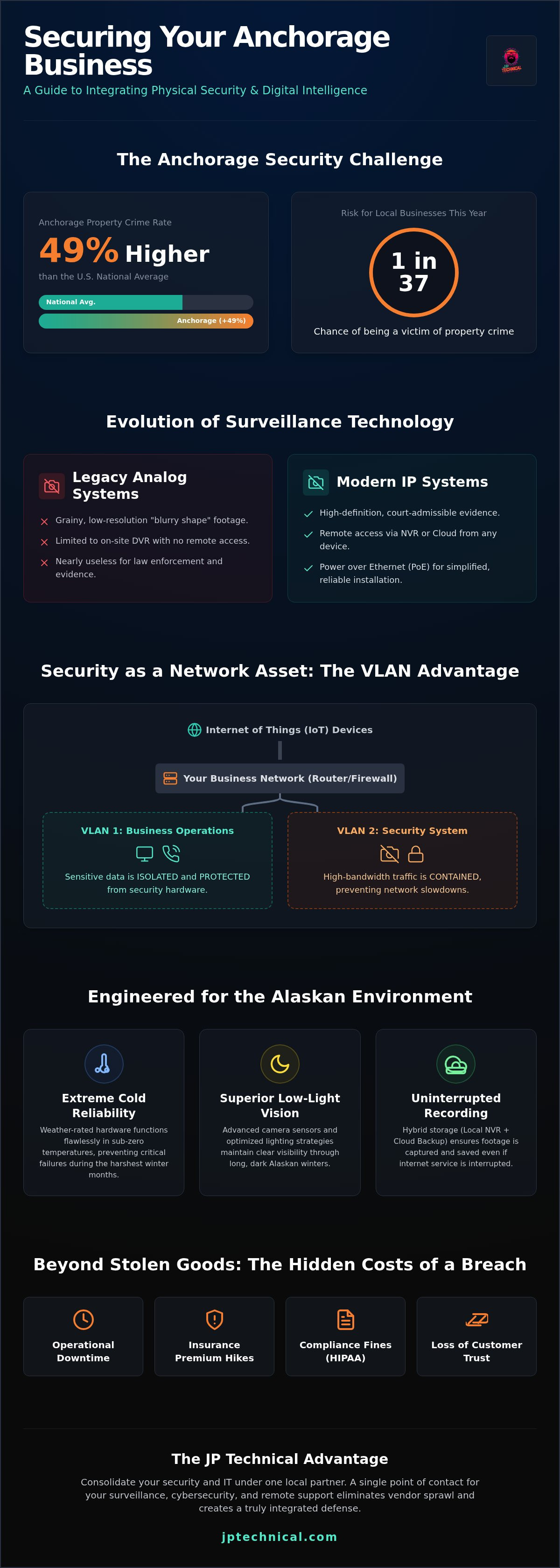
With property crime rates in Anchorage sitting 49% higher than the national average, local business owners face a 1 in 37 chance of being victimized this year. Protecting your livelihood requires more than a standard padlock. A professional commercial security system installation in Anchorage is no longer just a hardware purchase; it’s a critical network asset that must remain functional in extreme sub-zero temperatures while defending against modern digital intrusions. If your security provider doesn’t understand your IT network, they might be installing a vulnerability rather than a solution.
We know the frustration of juggling physical keys or worrying if your cameras will fail during a January cold snap. You deserve a “set-and-forget” environment where you can check your property from a smartphone and know your HIPAA compliance is solid. This 2026 guide explains how to integrate surveillance and access control to secure your physical and digital assets. We’ll cover the latest municipal building codes, remote monitoring benefits, and the specific hardware needed to survive an Alaskan winter while lowering your insurance premiums.
Key Takeaways
Modern security is a network asset. Learn how to protect your business by treating cameras as IoT devices and using VLAN segmentation to isolate surveillance traffic from sensitive data.
Traditional keys are a liability in 2026. Discover how integrated access control provides a tiered defense, giving you remote oversight of exactly who enters your facility and when.
Anchorage’s climate requires specialized planning. We explain how to choose weather-rated hardware and optimize lighting to maintain clear visibility during the darkest winter months.
A professional commercial security system installation in Anchorage ensures your physical defenses meet strict compliance standards like HIPAA while securing your digital perimeter.
Consolidating your security and IT under one local partner eliminates vendor sprawl. Understand the benefits of a single point of contact for your surveillance, cybersecurity, and remote support.
Table of Contents
Why Modern Commercial Security in Anchorage Requires a New Approach
Integrating Physical Security with Your Anchorage Business Network
Planning Your Anchorage Installation: Compliance and Environment
The JP Technical Advantage: Professional Security Installation
Why Modern Commercial Security in Anchorage Requires a New Approach
The way we protect local businesses has fundamentally changed. Commercial security is no longer a standalone hardware installation; it’s the convergence of physical barriers and digital network intelligence. In a city where property crime rates are 49% higher than the national average, a standard “off-the-shelf” camera won’t suffice. Choosing a professional commercial security system installation in Anchorage ensures your defense is built for the specific challenges of our region. If your provider doesn’t understand both your physical site and your IT network, they are leaving a door open for trouble.
Local data shows that Anchorage residents and business owners face a 1 in 37 chance of being a victim of property crime. These aren’t just numbers. They represent broken windows, stolen inventory, and compromised data. DIY systems often fail here because they lack the ruggedized build needed for sub-zero temperatures. If your hardware freezes in January, your security is non-existent. Modern systems have shifted from reactive recording to proactive, AI-driven threat detection that alerts you before a breach occurs.
From Analog to IP: The Evolution of Business Surveillance
Old analog systems relied on DVRs that produced grainy, “blurry shape” footage. These are nearly useless for law enforcement. Modern IP cameras utilize Network Video Recorders (NVR) or Cloud storage to deliver high-definition, court-admissible evidence. Most physical security principles now emphasize these digital standards because they offer superior clarity and remote accessibility. We use Power over Ethernet (PoE) to simplify the installation process. This technology allows a single cable to provide both power and data, reducing the need for complex wiring and improving system reliability during power fluctuations.
The Cost of Insecurity: Beyond Stolen Property
The impact of a break-in goes far beyond the value of stolen goods. You have to consider the hidden costs of operational downtime, employee anxiety, and the inevitable rise in insurance premiums. A professionally monitored system acts as a powerful deterrent. If a potential intruder sees high-grade surveillance and networked access points, they are more likely to move on. Proactive security is the integration of surveillance, access control, and real-time alerts. This layered approach creates a predictable environment where you can focus on running your business rather than worrying about what happens after hours.
Integrating Physical Security with Your Anchorage Business Network
A modern commercial security system installation in Anchorage is as much an IT project as it is a physical one. Every camera and sensor you add to your building is an Internet of Things (IoT) device. If these devices aren’t properly secured, they can become an easy entry point for hackers to access your sensitive business data. We treat your security hardware as part of your digital perimeter, ensuring it doesn’t create a vulnerability where you least expect it.
We use VLAN segmentation to keep your surveillance traffic separate from your primary business network. This practice ensures that even if a single camera is compromised, the rest of your network remains isolated and protected. It also helps with bandwidth management. High-definition 4K cameras generate a significant amount of data. By organizing your network traffic, we ensure your security feeds don’t slow down your office internet or disrupt daily operations.
Choosing between cloud and local storage requires a balanced approach, especially given Anchorage’s unique connectivity landscape. While cloud storage offers excellent redundancy and remote access, local NVR storage provides a reliable backup if your internet service is interrupted. We often recommend a hybrid solution during a commercial security system installation in Anchorage to ensure you never lose a second of footage. If you aren’t sure if your current network can handle the load, a free IT assessment can help identify potential bottlenecks before you install new hardware.
Cybersecurity at the Edge: Protecting Your Surveillance
Cheap security hardware often comes with default passwords and unpatched firmware, making them prime targets for cyberattacks. We apply strict Managed Cybersecurity principles to every installation. This includes changing all factory settings, enforcing strong encryption for video data at rest and in transit, and ensuring all equipment meets industry compliance standards for safety and performance. We don’t just hang cameras; we secure them.
Remote Management and Mobile Vigilance
Secure mobile apps allow you to monitor your Anchorage office from anywhere in the world. You can set up smart alerts that distinguish between routine activity, like a delivery driver, and a genuine security threat. By integrating your surveillance with Managed IT Services, we provide 24/7 uptime monitoring. This means if a camera goes offline or a hard drive fails, we know about it immediately and can fix the issue before it leaves you exposed.
Surveillance vs. Access Control: Building a Tiered Defense
A robust defense relies on layers. Surveillance acts as your eyes, documenting the “who” and “when” of every event on your property. Access control serves as your gatekeeper, dictating the “where” and “how” of movement throughout your facility. When you invest in a commercial security system installation in Anchorage, these two systems should work in tandem to create a comprehensive safety net. One observes while the other prevents, ensuring that no single point of failure leaves your business exposed.
In 2026, the traditional physical key is effectively obsolete for Anchorage businesses. Keys are easy to lose, expensive to copy, and impossible to track. If a key goes missing, you face the high cost of rekeying every lock. Modern keyless entry systems eliminate this risk entirely. Door badge systems allow you to track employee attendance and restrict access to sensitive areas like server rooms or inventory closets. This data is invaluable for maintaining operational order and meeting strict regulatory requirements.
Managing guests and deliveries also requires a modern touch. Integrating intercoms and video doorbells allows you to verify visitors before they ever step inside. You can grant access remotely from your desk or smartphone, ensuring your perimeter remains secure without disrupting your workflow. Following the CISA Cybersecurity Framework Implementation Guidance ensures that these connected entry points don’t become weak links in your overall security posture. We make sure your physical doors and your digital network are equally protected.
Modern Access Control Solutions
You have several options for securing your doors, ranging from traditional RFID badges to mobile credentials and biometric scanners. Mobile-first systems are increasingly popular because employees rarely lose their phones. One of the greatest benefits is the ability to handle employee departures. If an individual leaves the company, you can revoke their access instantly through a digital dashboard. There’s no need to chase down physical keys or call a locksmith. You can explore specific hardware options on our Physical Security page to see what fits your building’s layout.
Smart Surveillance Features That Matter
Today’s cameras do more than just record video. AI-powered license plate recognition (LPR) can secure your parking lot by alerting you to unauthorized vehicles. For retail shops, heat mapping helps you understand customer flow to optimize your floor layout. While facial recognition is a powerful tool, many businesses find that simple object detection, which distinguishes between humans and animals, is more than enough to reduce false alarms. A professional commercial security system installation in Anchorage helps you choose the features that provide the most value without overcomplicating your daily routine.
Planning Your Anchorage Installation: Compliance and Environment
Planning a commercial security system installation in Anchorage requires more than just picking hardware off a shelf. You have to account for the environmental extremes and specific regulatory hurdles that define our region. A system that works in the Lower 48 will often fail here because it isn’t built for our lighting cycles or temperatures. Successful deployment follows a methodical process to ensure your investment lasts for years rather than months.
Step 1: Conduct a site survey. Identify high-traffic entry points and potential blind spots where an intruder could hide.
Step 2: Evaluate lighting conditions. This is crucial for Anchorage’s dark winter months when natural light is scarce.
Step 3: Determine storage requirements. Your retention policies must align with your specific industry compliance needs.
Step 4: Select ruggedized hardware. Only use equipment with appropriate Ingress Protection (IP) ratings designed for Alaska weather.
Step 5: Professional cabling and mounting. Secure attachments prevent ice buildup from damaging your sensors or pulling cables loose.
If you skip the planning phase, you’ll likely face equipment failure exactly when you need it most. A poorly placed camera or a frozen motor can leave your business vulnerable for weeks. You can schedule a free IT assessment to ensure your security plan covers every physical and digital angle before you break ground.
The Alaska Factor: Extreme Weather and Lighting
Standard cameras often fail in the North. True winter-rated cameras must have internal heaters to prevent lens fogging and motor freeze. Without these heaters, pan-tilt-zoom (PTZ) cameras can become stationary blocks of ice by mid-December. We also prioritize IR (Infrared) and Starlight sensors. These technologies are essential for capturing high-quality video during our 19-hour winter nights. We also use specific mounting strategies to avoid snow-load damage, ensuring that heavy drifts don’t block your sensors or strain the mounting brackets.
HIPAA and Regulatory Compliance in Surveillance
If you operate a medical facility, your installation must follow strict privacy rules. You cannot place cameras in exam rooms or areas where patients have a reasonable expectation of privacy. Compliance also dictates your data retention; some auditors require 60 or 90 days of archived footage. Integrating your HIPAA Compliance strategies with your physical security ensures that your video data is encrypted and stored according to federal law. This prevents your surveillance system from becoming a liability during a regulatory audit.
The JP Technical Advantage: Professional Security Installation
Choosing the right team for your commercial security system installation in Anchorage is a decision that impacts your business for years. National “big box” providers often treat security as a one-size-fits-all hardware sale. They don’t understand the specific crime patterns in our local neighborhoods or how the January freeze affects external sensors. We take a different approach. As a local partner, we provide a single point of contact for your Managed IT, cybersecurity, and physical security needs. This integration eliminates vendor sprawl and ensures that every piece of your defense works together seamlessly.
If a camera feed drops, you don’t have to guess if it’s a network issue or a hardware failure. We handle the troubleshooting across the entire stack. This holistic view is essential for maintaining clear Pricing and predictable service level agreements. You won’t get caught in the middle of two vendors blaming each other for a system outage. We take full responsibility for the uptime and integrity of your system, ensuring your cameras are always recording and your software is always updated.
A Partner, Not a Vendor
Our “Steady Guardian” philosophy means we handle the technical complexities so you can focus on growing your business. We don’t just install equipment and disappear; we provide proactive care that includes regular firmware patches and hardware health checks. While our hub is in Anchorage, we proudly support businesses in Wasilla, Kenai, Palmer, and Fairbanks. JP Technical’s founding in 1996 stands as a testament to our local reliability and long-term commitment to the Alaskan business community.
Get Started with a Free Security Assessment
A professional site evaluation is the first step toward a secure environment. During our assessment, we don’t just look for where to hang cameras. We identify physical vulnerabilities, such as poorly lit entry points, and digital risks, like unpatched recording software. We analyze your network architecture to ensure your security traffic is optimized and isolated from your sensitive data. This thorough review gives you a clear roadmap for protecting your assets without overspending on unnecessary gadgets.
You deserve the peace of mind that comes from knowing your business is protected by experts who live and work in your community. Schedule your Free IT and Security Assessment today to build a defense that lasts.
Build a Future-Proof Defense for Your Anchorage Business
Effective security in 2026 demands more than just hanging cameras. It requires a tiered defense that merges physical access control with robust network cybersecurity. By choosing hardware rated for the Alaskan climate and integrating it with your existing IT infrastructure, you eliminate vulnerabilities and ensure your surveillance remains operational during our toughest months. Proactive maintenance and remote monitoring are no longer optional features; they’re essential components of a reliable business continuity plan.
A professional commercial security system installation in Anchorage gives you the peace of mind to focus on your core operations. Since 1996, JP Technical has acted as a steady guardian for businesses across Anchorage, Wasilla, Kenai, and Fairbanks. As HIPAA-compliant experts, we possess the technical mastery to protect your physical and digital assets simultaneously. We take pride in showing up when things get difficult and providing the long-term partnership your business deserves.
Secure your business with a Free IT & Security Assessment today. Let’s work together to build a predictable, safe environment for your team and your customers.
Frequently Asked Questions
How much does a commercial security system installation cost in Anchorage?
The total investment for a commercial security system installation in Anchorage varies based on your building’s square footage and the number of entry points. Factors like high-definition storage requirements and the need for extreme-weather-rated hardware influence the final scope. We focus on providing a scalable solution that balances your specific security needs with long-term reliability and network integrity.
Can I view my business security cameras from my phone?
Yes, modern systems provide secure remote access through encrypted mobile applications. You can view live feeds, review archived footage, and manage access permissions from anywhere with an internet connection. We prioritize setting up secure connections, such as VPNs or encrypted cloud gateways, to ensure your private video feeds aren’t vulnerable to unauthorized external access.
What is the difference between a security camera and a surveillance system?
A security camera is an individual piece of hardware that captures video, while a surveillance system is the entire integrated network of cameras, recorders, and software. A complete system manages how data is stored, how alerts are triggered, and how different devices communicate. For a professional commercial security system installation in Anchorage, we design the entire ecosystem to ensure no single camera acts as a standalone silo.
How long do security cameras store footage?
Most businesses store footage for 30 to 90 days, though this depends on your specific industry’s retention requirements. Medical facilities or financial institutions often require longer archives to remain compliant with federal audits. We calculate your storage needs based on camera resolution and frame rates to ensure you don’t run out of space or overwrite critical evidence prematurely.
Do I need a permit for commercial security camera installation in Alaska?
Anchorage requires all businesses with monitored alarm systems to register their system with the Anchorage Police Department. According to ordinance AO 2025-145(S), maintaining a valid permit is essential to manage false alarm penalties and ensure emergency services respond when needed. While the cameras themselves don’t always require a permit, the integrated alarm and monitoring components must follow municipal registration rules.
What happens to my security system if the power or internet goes out?
Professional installations include Uninterruptible Power Supplies (UPS) and local storage buffers to keep your system running during an outage. If the internet fails, your cameras continue to record directly to your local Network Video Recorder (NVR). Once connectivity is restored, the system syncs with the cloud, ensuring there are no gaps in your security timeline or evidence logs.
Are wireless security cameras good for Anchorage businesses?
Wireless cameras are generally not recommended for commercial applications in Anchorage because batteries fail quickly in extreme cold and signals can be unreliable. We prefer Power over Ethernet (PoE) installations, which use a single physical cable for both data and power. This hardwired approach provides the steady reliability needed to withstand Alaskan winters without the constant maintenance of battery replacements.
How does access control integrate with my existing employee badges?
We can often integrate modern smart readers with your existing RFID badges if they use compatible frequencies like 125kHz or 13.56MHz. During our initial site survey, we test your current credentials to see if they can be migrated to a new, more secure system. This allows for a seamless transition where employees keep their current badges while you gain advanced tracking and remote management capabilities.
 Article by
Colter Hobbs