Commercial Security Camera Installation in Anchorage: The 2026 Business Buying Guide
What if your security investment freezes solid the first time the temperature hits -30°F in January? In Alaska, a standard system isn’t just a poor choice. It’s a liability that often fails when you need it most. With Alaskans losing nearly $40 million to cybercrime in 2025, your physical surveillance must do more than just record video. It needs to protect your network and your reputation. Professional security camera installation in Anchorage requires a specific understanding of our unique environment, from the deep winter darkness to the technical demands of local HIPAA and financial compliance.
You likely already know that a camera is only as good as the footage it produces during the winter solstice. We agree that you shouldn’t have to choose between a secure building and a fast business network. This 2026 guide teaches you how to select and install a professional surveillance system that survives the sub-zero elements while keeping your data safe. We will look at the latest standards for 4K AI analytics, cloud integration, and the hardware specs required to ensure your business stays operational and compliant all year round.
Key Takeaways
Understand why IP67 weatherproofing and built-in heaters are non-negotiable for hardware to survive a sub-zero Anchorage winter.
Learn how the “Three-Deep” rule ensures your surveillance covers perimeters, building exteriors, and high-value internal areas effectively.
Discover why professional security camera installation in Anchorage must be treated as an IT workload to prevent network slowdowns and security gaps.
Identify the hidden risks of DIY setups, including mounting failures during high winds and vulnerabilities to cyber threats.
See how integrating physical cameras with access controls creates a unified, HIPAA-compliant security posture for your business.
Table of Contents
Choosing the Right Security Cameras for the Anchorage Environment
Professional Installation vs. DIY: The Last Frontier Reality
Choosing the Right Security Cameras for the Anchorage Environment
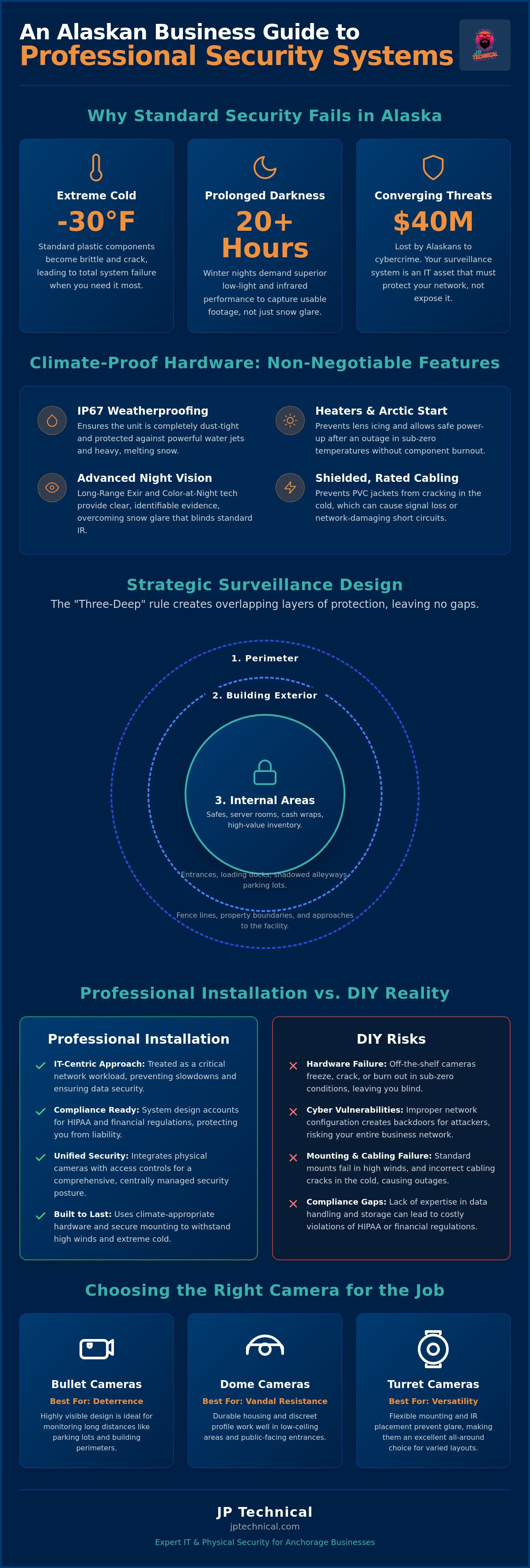
Anchorage businesses face environmental extremes that quickly expose the weaknesses in standard hardware. Most “off-the-shelf” residential cameras are designed for temperate climates. They often feature plastic components that become brittle and crack when temperatures stay below zero for weeks. If your hardware isn’t specifically rated for the Alaska climate, you risk total system failure during the most vulnerable months of the year. A successful security camera installation Anchorage requires looking beyond basic marketing specs to find industrial-grade durability.
Modern Closed-circuit television (CCTV) technology is highly capable, but its effectiveness depends on the physical integrity of the camera housing. We recommend hardware with an IP67 rating at a minimum. This ensures the unit is dust-tight and protected against powerful water jets or heavy, melting snow. For outdoor placements, heater-equipped housings are essential. These internal heaters prevent condensation and ice buildup on the lens, ensuring your view remains clear even during a mid-winter thaw-freeze cycle.
Performance during our 20-hour winter nights depends on Lux ratings. A Lux rating measures the minimum amount of light a camera needs to produce a usable image. In Anchorage, low-light performance is non-negotiable. While 4K resolution provides incredible detail, it requires significantly more storage space and bandwidth. Balancing clarity with disk space often means using efficient compression or motion-triggered recording. This ensures you have enough historical data stored on your NVR when you actually need to review an incident.
Extreme Weather Durability: Beyond the Spec Sheet
Look for industrial-grade cameras rated for -30°F or lower. High-quality units feature “Arctic Start” technology. This allows the camera to safely power up and warm its internal components after a power outage in sub-zero weather without burning out the circuitry. Additionally, ensure your installer uses outdoor-rated, shielded cabling. Standard PVC jackets will crack in the cold; this leads to signal loss or short circuits that can damage your wider business network. Professional security camera installation Anchorage projects prioritize these small hardware details to ensure long-term reliability.
Night Vision and IR Performance for Dark Winters
Standard infrared (IR) often struggles with snow glare, where the light bounces off falling flakes and “blinds” the sensor. Long-Range Exir technology provides more uniform illumination to reduce these hot spots and overexposed areas. For high-traffic areas, color-at-night technology is a superior choice. It allows you to identify the specific color of a vehicle or a person’s clothing in near-total darkness. This provides much better evidence for local law enforcement than grainy black-and-white footage. Integrating these specialized cameras into your physical security plan ensures your surveillance remains effective regardless of the season.
Strategic Surveillance Design: Maximizing Business Coverage
Effective security starts before a single drill touches a wall. A professional security camera installation Anchorage begins with a thorough vulnerability assessment. We look for the “soft” spots in your facility. This includes unlit loading docks, shadowed alleyways, and high-traffic cash wraps. By following the “Three-Deep” rule, we create overlapping layers of protection. This strategy covers the perimeter, the building exterior, and internal high-value areas like safes or inventory rooms. This methodical approach ensures no gap is left unmonitored and provides multiple angles of any suspicious activity.
Choosing the right form factor is a functional decision based on your building’s architecture. Bullet cameras are excellent for long-distance deterrence because they are highly visible. Dome cameras offer superior vandal resistance for low ceilings or public-facing areas. Turret cameras provide the most versatility for varied business layouts. Strategic placement often reduces the total number of cameras needed. If you position a wide-angle turret camera correctly, it can cover an entire lobby that might otherwise require two bullet cameras. This design efficiency lowers your hardware costs and reduces the load on your recording storage. Following the FTC security guide for businesses, we treat physical hardware as the first line of defense for your data and your facility.
Perimeter Security and Parking Lot Monitoring
Anchorage retail and industrial parks benefit from License Plate Recognition (LPR) cameras at main entrances. These capture clear plate data even in low light or heavy precipitation. It’s vital to account for the “Alaska factor” during design. Snow piles that grow throughout the winter can quickly block sightlines of cameras mounted too low. We also consider how seasonal landscaping changes might obscure views. We often link these external systems to access control installation in Anchorage to provide a complete record of who enters your property.
Interior Surveillance and Employee Safety
Internal cameras should balance the need for theft prevention with employee privacy. Wide-angle lenses work best for general lobby views or open floor plans. Varifocal lenses allow us to zoom in on specific areas, like a cash register or a secure doorway, without losing image quality. Protecting your server rooms and IT closets is critical to meeting managed IT services Anchorage standards for data security. These internal eyes prevent unauthorized physical access to your digital infrastructure. If you aren’t sure where your biggest gaps are, a free IT assessment can help identify potential risks before they become incidents.
The Convergence of Physical Security and Managed IT
Modern surveillance systems are no longer standalone hardware. They are sophisticated network devices that require the same level of care as your servers or workstations. When you plan a security camera installation Anchorage, you are essentially adding a significant workload to your existing IT infrastructure. Treating cameras as simple electrical wiring projects is a mistake that leads to dropped calls, slow database access, and network instability. We view every camera as a networked computer that must be integrated correctly to maintain your business’s operational health.
Power over Ethernet (PoE) has become the gold standard for reliable commercial setups. It allows a single cable to provide both electrical power and a high-speed data connection. This reduces the points of failure and simplifies the physical installation. However, the massive amount of data traveling through those cables can quickly overwhelm a standard business router. Unmanaged video traffic often “chokes” the bandwidth needed for VoIP phones and cloud-based applications. Without proper configuration, your new security system could inadvertently disrupt your daily operations.
Securing the “back door” of your network is equally important. Many low-end cameras have unpatched vulnerabilities or weak default settings. These devices can become a gateway for hackers to enter your broader network and access sensitive files. We ensure every camera is hardened with unique credentials and isolated from your primary data environment to prevent unauthorized lateral movement across your network.
Bandwidth Management and NVR Configuration
Calculating bitrates is a critical step in the design process. A single 4K camera can consume significant bandwidth depending on the frame rate and compression used. We use Virtual Local Area Networks (VLANs) to isolate camera traffic. This keeps your surveillance data on its own “lane,” preventing it from interfering with sensitive financial records or customer data. For Anchorage businesses, we typically recommend a hybrid storage approach. Local storage on a Network Video Recorder (NVR) provides instant access to high-resolution footage, while critical clips are backed up to the cloud. This ensures redundancy without draining your entire internet connection during business hours.
HIPAA and Regulatory Compliance in Surveillance
For medical and financial offices, surveillance involves more than just catching intruders. It requires strict adherence to privacy laws. We ensure camera placement in clinics avoids exam rooms or areas where patient charts and screens are visible. Meeting HIPAA compliant IT standards also means encrypting recorded footage both at rest and in transit. Your retention policy must also align with legal requirements, which often dictate storing footage for at least 30 to 90 days. Professional security camera installation Anchorage includes setting up automated deletion cycles that keep you compliant with state and federal laws without requiring manual oversight.
Professional Installation vs. DIY: The Last Frontier Reality
Choosing a DIY kit from a big-box retailer might seem like a cost-saving measure, but it often leads to higher expenses in the long run. These consumer-grade systems frequently suffer from hardware incompatibility and significant security holes. A professional security camera installation Anchorage ensures that your hardware is vetted for the specific demands of our region. DIY setups often lack the encryption and robust mounting needed to protect a commercial enterprise. We’ve seen many businesses struggle with cameras that lose connection because of poor network configuration or cheap cabling that couldn’t handle the first frost.
Physical resilience is a major factor in Alaska. Anchorage experiences high wind speeds and frequent seismic activity. Professional mounting isn’t just about sticking a camera to a wall; it involves using industrial-grade brackets and anchors that withstand heavy vibrations. If a camera shifts even a fraction of an inch during a windstorm, your strategic coverage is ruined. We prioritize structural integrity so your system remains focused on its target regardless of the weather. This “boots on the ground” expertise is why we serve clients from Wasilla to Kenai and Fairbanks with a commitment to local accountability.
Moving from a reactive mindset to a proactive one is the hallmark of a secure business. Instead of waiting for a camera to fail, we implement a strategy of continuous vigilance. This transition ensures your surveillance system is a reliable asset rather than a source of frustration. A local partner understands that when a system goes down in the middle of a dark December, you need a specialist who can show up and resolve the issue quickly.
The Installation Process: What to Expect
Our process begins with an initial site walk-through to identify physical and digital vulnerabilities. This is often integrated with a free IT assessment to ensure your network can handle the new data load. We focus on structured cabling, which keeps your server racks organized and manageable. A neat rack isn’t just about aesthetics; it’s about heat management and easy troubleshooting. Once the physical work is done, we conduct thorough system testing and provide employee training on mobile viewing apps so you can monitor your business from anywhere.
Ongoing Support and Maintenance
Surveillance hardware requires regular attention to remain effective. Firmware updates are a critical but often forgotten step. Without them, your cameras are vulnerable to botnets and cyberattacks. We also perform physical inspections and lens cleanings, especially after major weather events that can leave salt or dirt buildup on the glass. Our pricing models for managed security services provide a predictable way to maintain your system’s health. If you are ready to secure your facility with a system built for the North, we recommend starting with a free IT assessment to map out your needs.
Securing Your Anchorage Business with JP Technical
JP Technical approaches security from a unique perspective. We don’t just see cameras; we see critical network endpoints. Our “IT-First” philosophy ensures that your security camera installation Anchorage is fully integrated into your digital environment. This means your surveillance won’t just record video; it will actively contribute to your overall security strategy. Since 1996, we’ve lived and worked here. We understand the specific risks local businesses face, and we believe a proper security camera installation Anchorage should be a one-time investment that lasts for years.
A unified security posture is more than just a buzzword. It’s the practical result of linking your cameras with physical access controls. When someone swipes a badge at your front door, your system should automatically tag the corresponding video footage. This level of integration simplifies your management tasks and provides concrete evidence for any incident. We build these custom-fit solutions for medical clinics, law firms, and industrial warehouses throughout the region. Each sector has different requirements, and we possess the technical mastery to meet them precisely.
A Partnership Beyond the Camera
Choosing a local provider means you aren’t just buying hardware; you’re gaining a dedicated ally. We combine proactive cybersecurity vigilance with physical monitoring to create a comprehensive shield for your operations. You won’t have to navigate a national call center or explain the Alaska climate to a technician in another time zone. Instead, you get direct access to seasoned Alaska professionals who know your facility and your network. This single point of contact for all IT and security needs reduces confusion and ensures that issues are resolved quickly. We value human connection and long-term stability over automated interactions.
Next Steps for Your Business
Securing your facility for the future requires a plan that grows with you. As your business evolves in 2026, your surveillance needs will likely change as well. We start by scheduling a thorough on-site security and network evaluation. This allows us to identify your specific vulnerabilities and design a system that fits your budget and your goals. We’re ready to help you move from a reactive state to one of steady, predictable safety. Protect your premises today with a professional security camera installation and experience the peace of mind that comes with local expertise.
Building a Resilient Security Strategy for the North
Securing your facility in Alaska requires more than just mounting hardware to a wall. It demands a system that survives -30°F temperatures and integrates seamlessly with your business network. By prioritizing industrial-grade components and strategic design, you ensure your investment provides clear evidence when it matters most. Modern surveillance is an IT workload. Proper configuration prevents network bottlenecks and protects your sensitive data from external threats. A professional approach ensures your cameras remain an asset rather than a liability during our long winter months.
JP Technical has served as a local Anchorage expert since 1996. We are HIPAA-compliant security specialists who provide a unique, integrated approach to managed IT and physical surveillance. You don’t have to navigate these technical hurdles alone. Our team is ready to help you design a system that meets your 2026 growth goals while maintaining local accountability. We understand the “Alaska Factor” because we live and work here too.
Ready to identify the gaps in your current setup? Request a Free Security & IT Assessment to start your security camera installation Anchorage project with a partner you can trust. We look forward to helping you protect what you’ve built.
Frequently Asked Questions
Do I need a permit for security camera installation in Anchorage?
Generally, Anchorage does not require a specific permit for low-voltage security systems. However, you must adhere to Alaska’s one-party consent laws if you record audio. It is also illegal to place cameras where there is a reasonable expectation of privacy, such as bathrooms. We recommend reviewing these legal requirements before starting your security camera installation Anchorage project to ensure full compliance with state statutes.
Will security cameras work during a power outage in Alaska?
Your cameras will only function during an outage if they are connected to a backup power source. We typically install Uninterruptible Power Supplies (UPS) on the Network Video Recorder and PoE switches. This provides a bridge of power during short outages or gives your generator time to kick in. Without these backups, your business remains vulnerable during winter storms when power reliability is most often compromised.
How much bandwidth do commercial security cameras use?
Bandwidth usage varies based on resolution, but a single 4K camera typically requires between 4 and 8 Mbps. If you have a 16-camera system, the data load is substantial. We manage this by isolating the surveillance traffic on a dedicated VLAN. This prevents the video stream from interfering with your VoIP phones or cloud-based software, ensuring your business operations stay fast and responsive while your cameras record.
What is the difference between NVR and DVR for business surveillance?
The primary difference is how the video data is processed. NVRs work with IP cameras to process digital data at the camera level before sending it to the recorder. DVRs are for older analog systems that process raw data at the recorder itself. For a modern security camera installation Anchorage, we always recommend NVR systems. They offer higher resolutions, better encryption, and easier scalability for growing local businesses.
Can I view my Anchorage business cameras from my phone while traveling?
Remote viewing is a standard feature for modern commercial systems. You can access live feeds and recorded footage from your smartphone or laptop anywhere in the world. We set up secure, encrypted connections to ensure your data isn’t exposed to the public internet. If your business has a stable upload speed, you can check on your facility in Anchorage while traveling, providing you with constant peace of mind.
How long do security cameras typically last in the Alaska climate?
Industrial-grade cameras rated for -30°F typically have a lifespan of 5 to 7 years in Alaska. The extreme temperature swings and moisture levels are hard on electronic components. Residential cameras usually fail much sooner, often within one or two seasons. Investing in hardware with internal heaters and “Arctic Start” technology is the only way to ensure your system survives the long-term environmental challenges of the North.
Is wireless or wired better for commercial security cameras?
Wired Power over Ethernet (PoE) is the superior choice for commercial applications. Wireless cameras are prone to signal interference from other office devices and physical obstructions like concrete walls. A wired connection provides a stable data stream and consistent power through a single cable. This reliability is essential for businesses that need 24/7 monitoring without the risk of a camera “dropping” from the network during a critical event.
How does security camera installation impact my insurance premiums?
Installing a professional surveillance system can lead to lower commercial insurance premiums. Insurers view these systems as a proactive way to reduce the risk of theft and vandalism. Additionally, high-definition footage provides clear evidence for liability claims, which can protect you from fraudulent lawsuits. You should contact your insurance agent to see if your new system qualifies you for a specific safety or security discount.
 Article by
Colter Hobbs